What Does ")" Mean in Chat? The Bracket Smiley, Explained
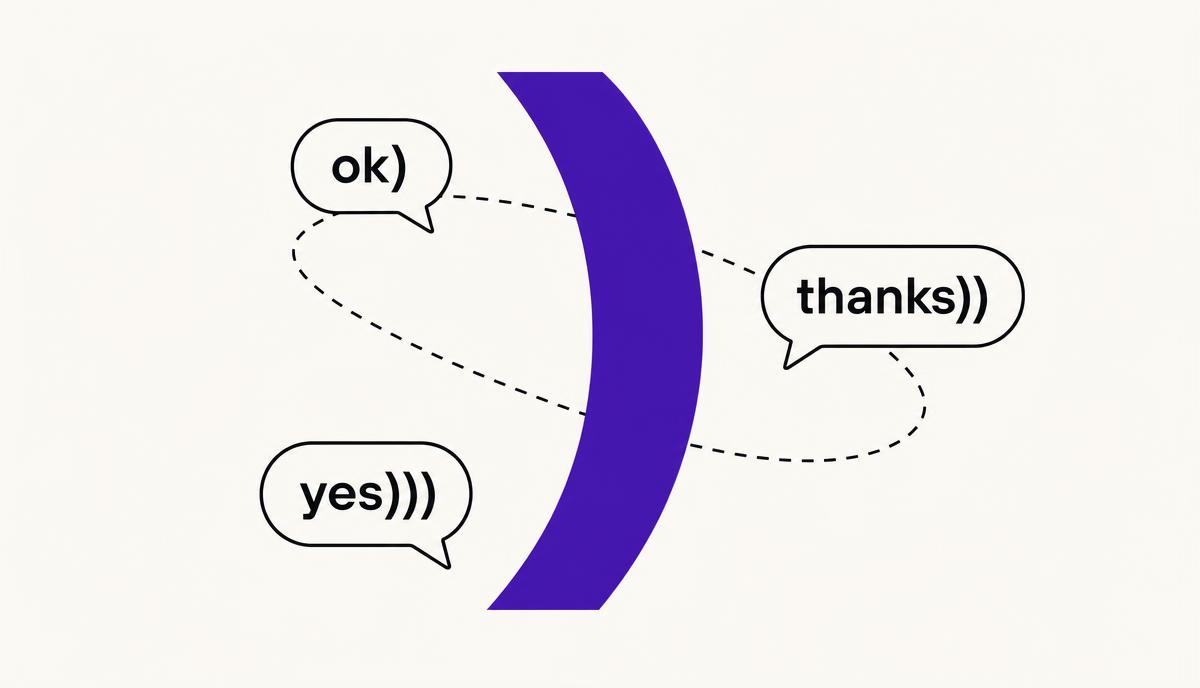
A lone ")" at the end of a message is a smiley with the eyes left off — and a strong signal you are talking to someone from Eastern Europe. Here is what it means, why it exists, and how to read it correctly.
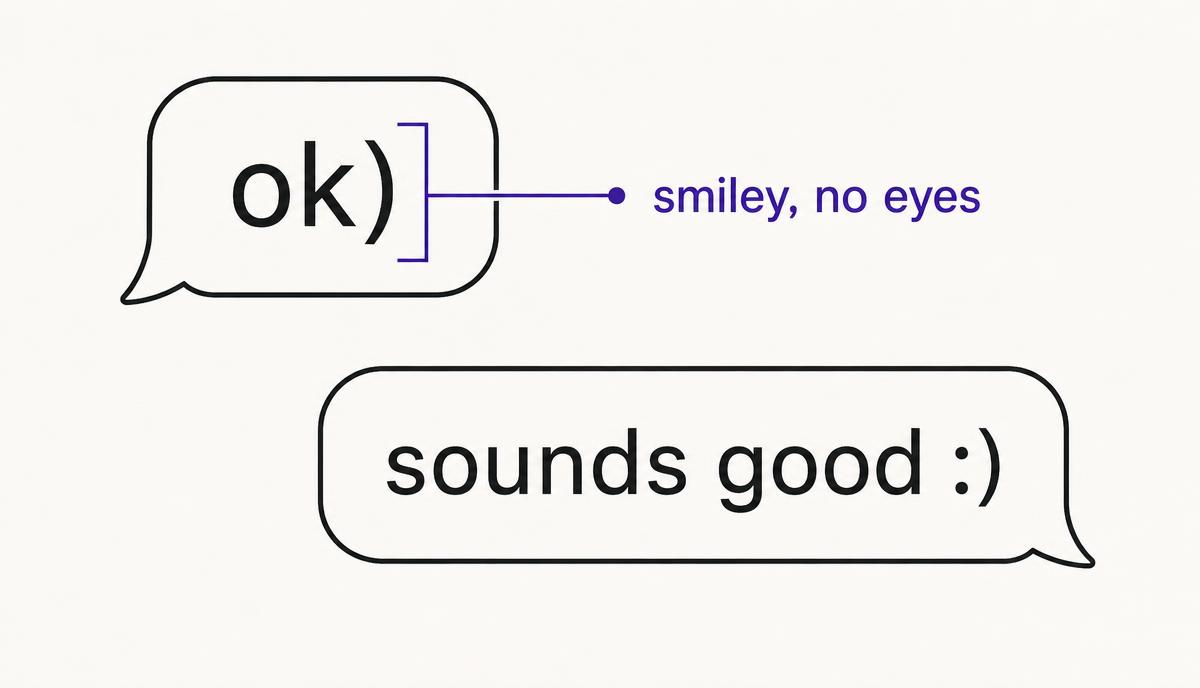
A closing parenthesis at the end of a message — "ok)", "thanks))" — is a smiley face with the eyes left off. It means the same thing as :) does in English-language chat: friendliness, warmth, no hard feelings. If someone writes it habitually, they are almost certainly from Russia, Ukraine, Belarus, Kazakhstan or elsewhere in Eastern Europe, or they learned to text from someone who was.
It is one of the clearest examples of something that happens constantly in international chat: a punctuation habit that is completely unremarkable in one culture and completely opaque in another. Reading it wrong makes a warm message look abrupt, or a neutral one look sarcastic.
What ")" actually means
Take the standard Western smiley, :) — a colon for eyes, a parenthesis for the mouth. Now delete the colon. What remains is the mouth: ). That is the whole convention. The eyes were dropped because they were redundant; the curve alone already reads as a smile once everyone in your chat knows the code.
The important part is that it is not lazy or careless. It is a fully conventional piece of punctuation in the languages that use it, as normal as an exclamation mark. Writing "ok" without the bracket, to someone raised on this habit, can read as noticeably cold — the same way a bare "Fine." reads cold in English.
Why more brackets mean more warmth
The convention scales. One bracket is a polite smile. Two or three is genuine amusement or real enthusiasm. A long run — "))))))" — is laughter, roughly equivalent to "haha" or a crying-laughing emoji. Unlike :) which does not repeat naturally, the bracket smiley has a built-in volume control, and native users make constant use of it.
| What they write | Rough English equivalent | Tone |
|---|---|---|
| ) | :) or a light nod | Polite, friendly, softening the sentence |
| )) | A real smile | Genuinely pleased or amused |
| ))) | haha | Laughing, informal, relaxed |
| )))))) | A crying-laughing emoji | Something was actually very funny |
| ( or (( | :( | Disappointed, sorry, sympathetic |
| No bracket at all | A full stop | Neutral — or, in a warm thread, noticeably cool |
The mirror image matters too: an opening bracket "(" is a frown. "Sorry, cannot make it (" is not a typo or an unclosed parenthesis. It is an apology with a sad face attached.
Where the habit comes from
The convention grew out of the early Russian-language internet — ICQ, forums, and SMS in the late 1990s and early 2000s. Two practical pressures shaped it. Cyrillic keyboard layouts make switching to Latin punctuation slightly awkward, and SMS messages in Cyrillic were capped at 70 characters instead of 160, so every character had a real cost. Dropping the colon saved a keystroke and a character, and the meaning survived intact.
What began as compression became a norm. It outlived both the character limits and ICQ, and today it is used fluently by people who have never seen a 70-character SMS — including in English-language messages written by Eastern European speakers, which is where most confusion starts.
How it gets misread
To a reader who does not know the convention, a trailing ")" looks like a typing error, an unclosed bracket, or — worst case — sarcasm. That last reading is the damaging one. A message like "can you send it by 5))" is written as a friendly nudge and can be received as passive aggression, especially over work chat where nobody has the tone cues to correct the guess.
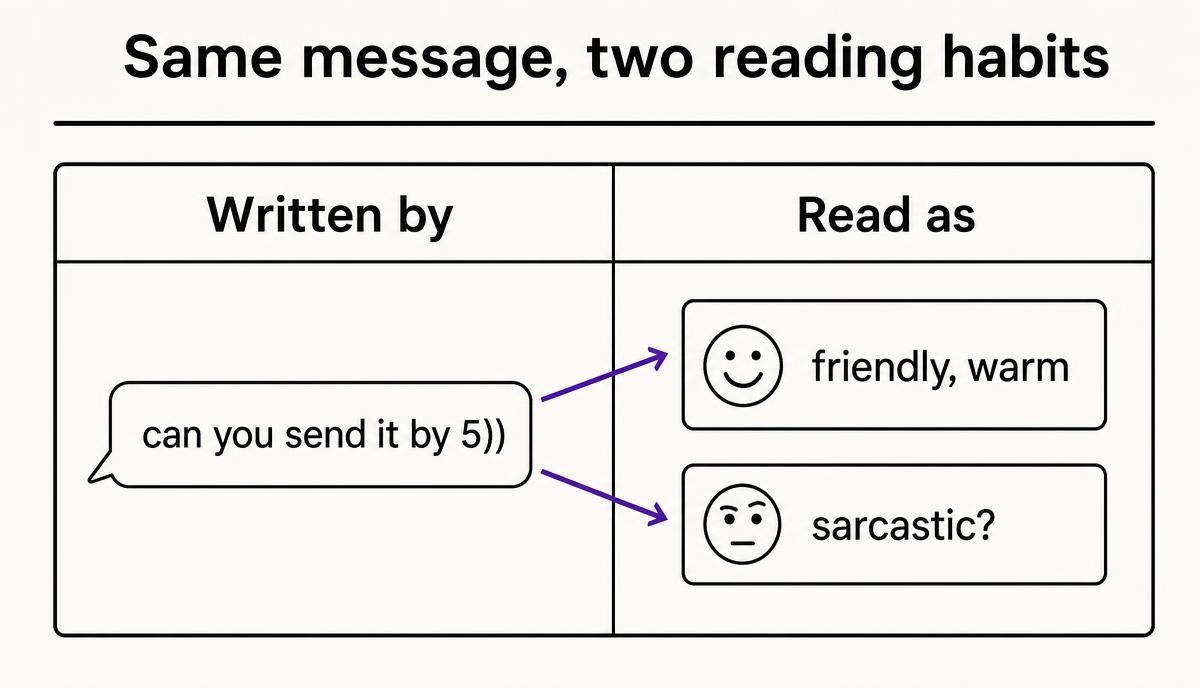
This is the general failure mode of text: the sender encodes tone in a marker the reader does not decode. It is the same mechanism behind full stops reading as anger to younger readers, or a thumbs-up emoji reading as dismissive. We cover why written messages lose tone so reliably in the psychology of digital messaging, and how tone markers substitute for physical cues in body language in the digital age.
The same message, five different conventions
The bracket smiley is one entry in a much longer list. Every messaging culture has developed its own shorthand for "I am being friendly", and none of them are self-explanatory to outsiders.
| Marker | Where it is common | What it means |
|---|---|---|
| ) or )) | Russia, Ukraine, Belarus, Kazakhstan, Baltics | Smile; more brackets, more warmth |
| ^^ or ~ | Japan, Korea, Taiwan | Softening; the tilde lightens a request |
| 555 | Thailand | Laughter — "5" is pronounced "ha" |
| kkkkk | Brazil | Laughter, equivalent to "hahaha" |
| jajaja | Spanish-speaking countries | Laughter |
| xD, :D, lol | US, UK, most English-language chat | Amusement |
| 🙏 | Global, but read very differently | Thanks or please in much of Asia; prayer or pleading elsewhere |
Notice that most of these are not translations of each other. They carry different intensities and fit different registers. "555" is casual in a way that "haha" is not; the Japanese tilde softens a demand in a way English punctuation has no direct equivalent for. The broader pattern — high-context versus low-context communication, directness norms, how disagreement is signalled — is covered in the impact of cultural differences on communication.
How to respond when you see it
Nothing dramatic is required. Read the bracket as a smile, respond to the content of the message, and let the tone marker do its job. A few practical rules make cross-cultural chat much less error-prone.
- Assume warmth, not sarcasm. Unfamiliar punctuation is far more likely to be a convention you do not know than an insult aimed at you.
- Do not correct it. Pointing out an "unclosed bracket" is the international-chat equivalent of correcting someone's accent.
- Mirror lightly if you want to. Using ")" back signals that you understood — but only if it feels natural. Forced mirroring reads as mimicry.
- Keep your own markers explicit in mixed groups. Write "no rush" or "genuinely, thank you" rather than relying on an emoji to carry the whole tone.
- When a message reads oddly sharp, re-read it assuming the friendliest plausible intent. If it still reads sharp, ask directly rather than escalating.
What this tells you about writing across cultures
The bracket smiley is a small thing, but it makes a general point precisely: tone in text is carried by conventions, and conventions are local. The safest writing for an international audience does not rely on markers at all. It states intent in words — "this is not urgent", "no criticism intended, just checking" — because words survive translation across chat cultures in a way punctuation does not.
That is exactly the check SpeakWise runs on a draft: it flags where your tone depends on a cue the reader may not share, and rewrites the line so the intent is explicit. If you regularly write to colleagues in other countries, that one habit removes most of the misreadings before they happen. See how tone analysis works.
Frequently asked questions
Is ")" rude or sarcastic?
No. It is a smile. It is used to soften a message, not to add an edge. The sarcastic reading is an artefact of unfamiliarity, not of intent.
Does a single ")" mean something different from "))))"?
Yes, in degree rather than kind. One bracket is a polite smile that softens the sentence. Four or more is laughter. The count works like volume, and native users are quite precise about it.
What does "(" mean then?
A frown — the equivalent of :(. "Cannot join today (" is an apology with a sad face, not a stray keystroke.
Does it definitely mean the person is Eastern European?
It is a strong signal, not proof. The convention spread across the Russian-speaking internet and is standard across Russia, Ukraine, Belarus, Kazakhstan and much of the Baltics and Caucasus. It also gets picked up by anyone who spends a lot of time in those chat groups, so treat it as a good guess rather than a certainty.
Should I use it myself?
Only if it comes naturally in a chat where everyone already uses it. In mixed or professional groups, prefer plain words or a standard emoji — the point of a tone marker is to be understood, and one that needs explaining does not qualify.
Why not just use emoji?
Emoji are not neutral either. 🙏 reads as thanks in much of Asia and as prayer or pleading elsewhere; 👍 reads as acknowledgement to some people and as dismissal to others. Emoji move the ambiguity, they do not remove it. Explicit wording is the only marker that travels reliably.
Related Articles
The Psychology of Digital Messaging
Why written messages get misread, how tone gaps and negativity bias distort chat and email, and what to change so your intent survives the screen.
How to Set Boundaries at Work (Without Sounding Difficult)
A practical guide to setting boundaries at work: the four kinds of limits worth defining, the sentences that hold them, how to handle pushback, and what to do when the boundary keeps getting crossed.
How to Ask for a Raise by Email (Templates and Scripts)
A practical guide to writing the email that asks for a raise: when to send it, what evidence belongs in it, three templates you can adapt, and the wording that keeps the tone confident rather than apologetic.