SpeakWise Blog
Insights and tips for effective communication in all contexts
Filter by topic:
Mastering Professional Communication
How to write and speak at work so people understand you the first time: structure, tone, channel choice and scripts for the hard conversations.
Professional communication is mastered by doing three things consistently: state what you need early, choose a tone that is direct without being harsh, and match the channel to the weight of the message. Everything else is refinement. If you fix only those three habits, most of the confusion, chasing and quiet friction in your working week disappears.
The Psychology of Digital Messaging
Why written messages get misread, how tone gaps and negativity bias distort chat and email, and what to change so your intent survives the screen.
Digital messages get misread because readers supply the missing tone themselves, and under pressure they supply a negative one. Text removes voice, face and timing, so the reader fills those gaps with their own mood, their history with you, and whatever else is happening in their day. Writing well online is mostly about leaving fewer gaps to fill.
Passive vs. Assertive vs. Aggressive
The difference between passive, assertive and aggressive communication, how each one sounds in real messages, and how to move to the assertive middle.
Passive communication protects the relationship at the cost of your needs. Aggressive communication does the opposite. Assertive communication states your need plainly while treating the other person as an equal, which is why it is the only one of the three that tends to work twice with the same person.

Crafting Compelling Email Subject Lines
How to write subject lines that get opened and answered: naming the topic, adding the action, sizing for mobile, and the patterns that quietly kill replies.
A subject line has one job: tell the reader what this message is about and what it wants from them, in the width of a phone screen. Almost every weak subject line fails one of those two halves — it names a topic with no action, or it hints at an action with no topic. Fix both and your email stops sitting unread at the bottom of someone's afternoon.

Body Language in the Digital Age
How non-verbal cues survive, distort and disappear on video calls — and how to read others and present yourself clearly when the body is reduced to a rectangle.
On a video call, most of your body language is gone and the rest is unreliable. What remains is a cropped head and shoulders, a delayed audio track, and a gaze that never quite meets anyone's. Reading people well in that setting means knowing which signals still carry information, which ones the medium invents, and which ones you should stop trying to interpret at all.

The Art of Active Listening
Active listening is a set of behaviours, not a state of mind: how to listen for the real point, reflect it back accurately, and use the same skill in writing.
Active listening means demonstrating, out loud, that you have understood what the other person meant — not merely staying quiet while they talk. The test is simple: can you state their point in your own words well enough that they say "yes, exactly"? If you can, you were listening. If you cannot, you were waiting.

Navigating Difficult Conversations
A practical framework for raising hard topics at work: how to prepare, open, hold your position under pressure, and close with something that actually changes.
A difficult conversation goes well when you name the issue plainly in the first thirty seconds, describe its effect without assigning motives, and then stop talking long enough to hear the other side. Most of the pain people associate with these conversations comes from the two failure modes around that: avoiding the topic until it hardens, or arriving with a verdict already written.

The Impact of Cultural Differences on Communication
How directness, context, hierarchy and time expectations shape cross-cultural communication at work — and how to adapt without stereotyping the person in front of you.
Cross-cultural misunderstanding at work is rarely about language. It is about unspoken defaults: how directly a "no" is expressed, how much meaning sits in the context rather than the words, how openly a junior person may disagree, and what a deadline is understood to mean. Two people can use the same English sentence correctly and walk away with opposite conclusions.

Writing for Clarity: Simplifying Complex Ideas
How to explain complicated things simply without dumbing them down: structure, sentence craft, concrete language, and the revision passes that do the real work.
Clear writing is not simple writing. It is writing where the reader spends all of their effort on the idea and none of it on the sentence. That comes from three things: deciding what the reader actually needs, putting the conclusion before the reasoning, and cutting every word that is doing no work. Vocabulary is the last and smallest part.

Professional Email Etiquette: A Practical Guide
How to write professional emails that stay warm, clear and respectful — from subject line to sign-off
Email etiquette is the set of habits that make a written message easy to read, easy to answer and hard to misread. Email strips out voice, face and timing, so the same sentence can land as efficient or as cold depending on a handful of small choices. This guide walks through those choices in the order you actually make them: subject, greeting, request, tone, detail, sign-off and reply.

How to Say No at Work Without Guilt
A practical script for declining requests clearly, kindly and without damaging the relationship
Saying no is the clearest test of assertive communication. Most people fail it in one of two directions: they agree to everything and quietly drown, or they refuse so bluntly that the relationship takes the damage instead of the calendar. Neither is necessary. A good no is short, specific and warm, and it fits in about three sentences.
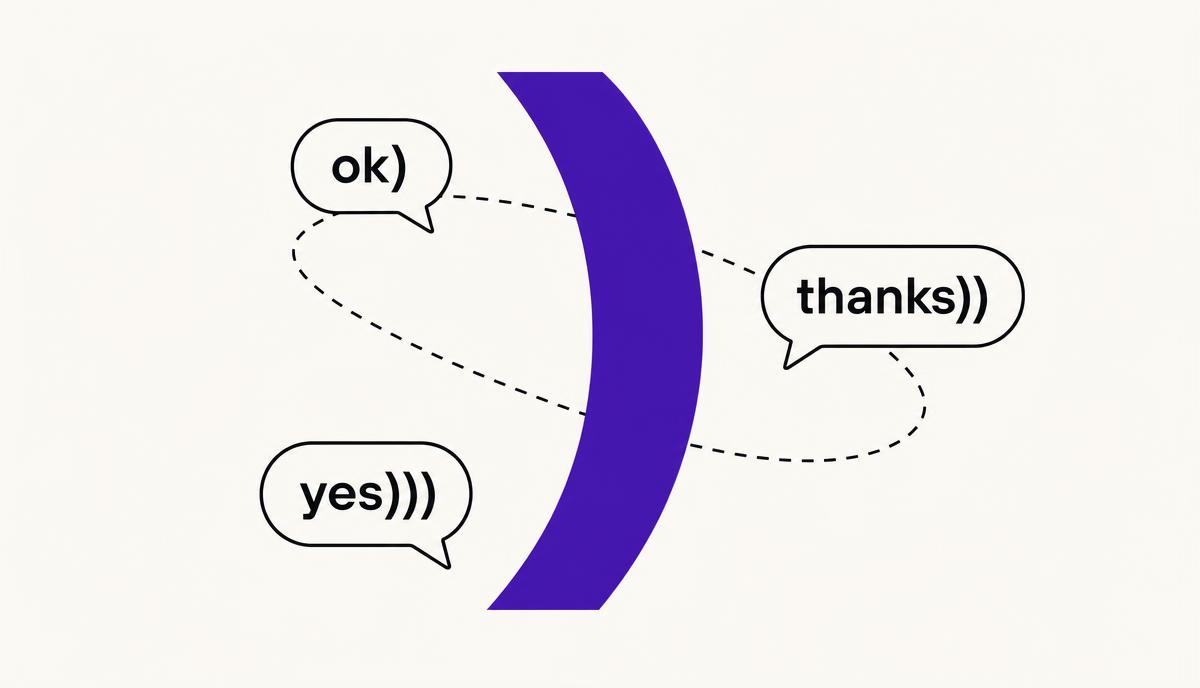
What Does ")" Mean in Chat? The Bracket Smiley, Explained
A lone ")" at the end of a message is a smiley with the eyes left off — and a strong signal you are talking to someone from Eastern Europe. Here is what it means, why it exists, and how to read it correctly.
A closing parenthesis at the end of a message — "ok)", "thanks))" — is a smiley face with the eyes left off. It means the same thing as :) does in English-language chat: friendliness, warmth, no hard feelings. If someone writes it habitually, they are almost certainly from Russia, Ukraine, Belarus, Kazakhstan or elsewhere in Eastern Europe, or they learned to text from someone who was.
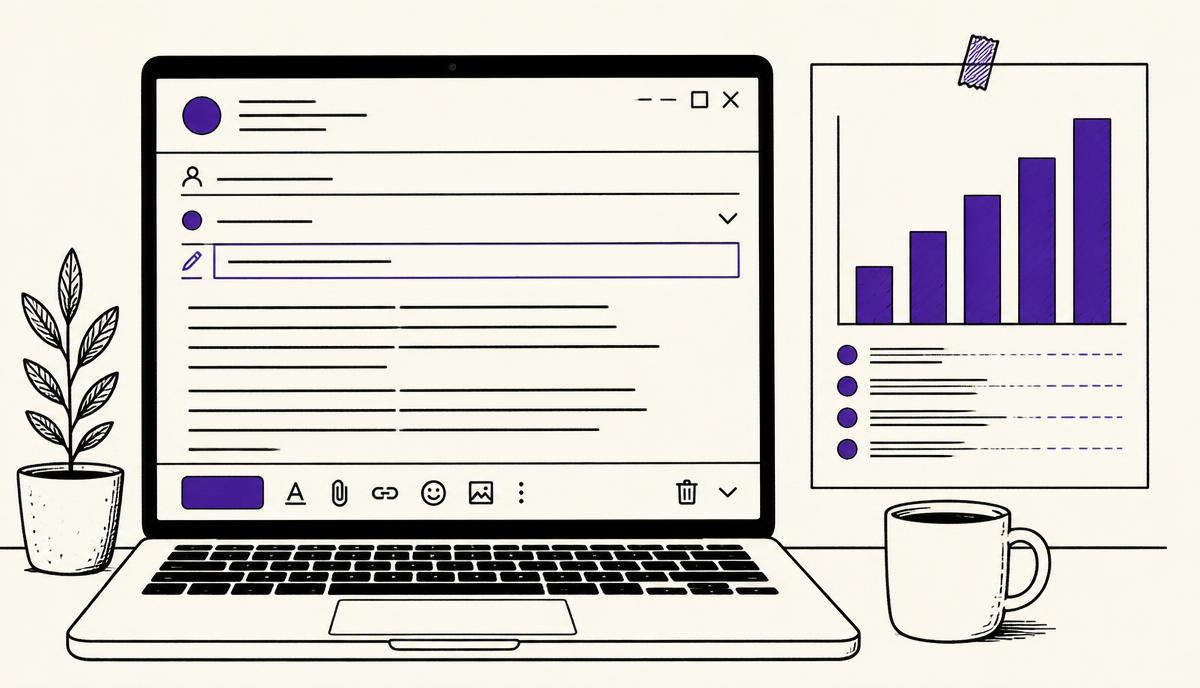
How to Ask for a Raise by Email (Templates and Scripts)
A practical guide to writing the email that asks for a raise: when to send it, what evidence belongs in it, three templates you can adapt, and the wording that keeps the tone confident rather than apologetic.
Asking for a raise by email feels safer than asking in person, and it has one real advantage: you get to choose every word. It also has one real risk — nothing softens a badly framed sentence when there is no tone of voice attached to it. A raise email works when it is short, specific, unapologetic, and ends with a request for a conversation rather than a demand for a number.
How to Set Boundaries at Work (Without Sounding Difficult)
A practical guide to setting boundaries at work: the four kinds of limits worth defining, the sentences that hold them, how to handle pushback, and what to do when the boundary keeps getting crossed.
Setting boundaries at work is mostly a communication problem, not a courage problem. Most people already know which parts of their week are unsustainable. What they lack is a sentence that states the limit plainly, without an apology in front of it and without an argument attached to the end. That sentence is the whole skill.