The Art of Active Listening

Active listening is a set of behaviours, not a state of mind: how to listen for the real point, reflect it back accurately, and use the same skill in writing.
Active listening means demonstrating, out loud, that you have understood what the other person meant — not merely staying quiet while they talk. The test is simple: can you state their point in your own words well enough that they say "yes, exactly"? If you can, you were listening. If you cannot, you were waiting.
Listening is a behaviour, not an intention
Almost everyone believes they listen well, because from the inside, listening and waiting feel identical. Both involve silence, eye contact and an attentive expression. The difference is invisible to the listener and completely visible to the speaker, who can tell within one reply whether their point landed or bounced.
That is why active listening is best treated as a set of observable actions rather than a mental attitude. You cannot verify your own attention, but you can verify whether you paraphrased, whether you asked a question about what they said rather than what you wanted to say, and whether the other person confirmed your reading. Those are checkable.
The three things that displace listening
Rehearsing is the most common: composing your reply while the other person is still constructing their point, so you hear the first third and imagine the rest. Solving is the second: identifying the problem early and spending the remaining time queuing advice nobody requested. Filtering is the third and subtlest: hearing only the parts that relate to your own position, which is why two people can leave the same conversation with entirely different accounts of it.
The core loop: attend, reflect, confirm
Strip active listening down and there is one repeatable loop. Attend without composing. Reflect the substance back in your own words. Confirm or correct. Then, and only then, respond with your own view.
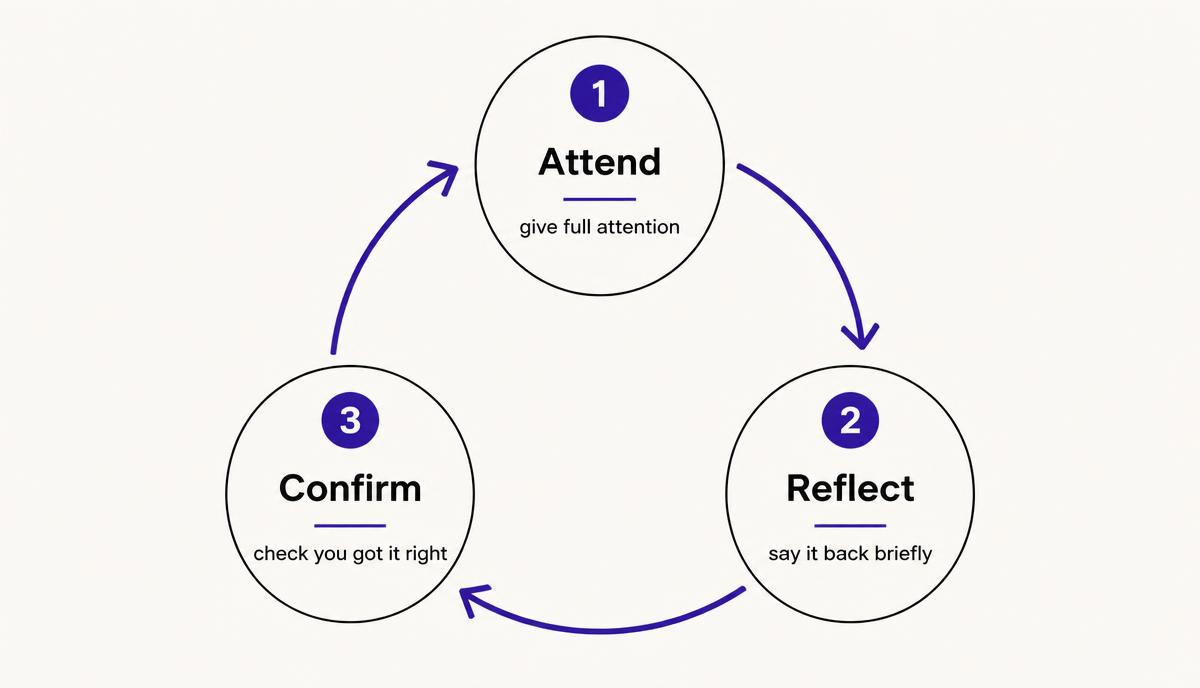
Reflecting is the part people skip, usually because it feels artificial. It does not have to be a formal paraphrase. "So the blocker is the data migration, not the design work?" does the entire job in eleven words. What matters is that you translate rather than repeat — echoing someone's exact phrasing back at them signals transcription, not comprehension.
Reflect the meaning, not just the facts
A useful reflection often names the thing under the sentence. If a colleague says "I can take it on, it is fine, I will move the other deadlines", the fact is capacity and the meaning is cost. "It sounds like you can do it, but something else has to slip — which one?" acknowledges both. Reflecting only the facts back can make a person feel processed rather than heard.
Silence is a tool
Most people fill a pause within a second or two. Extending it slightly is the cheapest listening technique there is, because the second thing someone says after a silence is usually more honest than the first. This is uncomfortable at first and stops being uncomfortable surprisingly quickly.
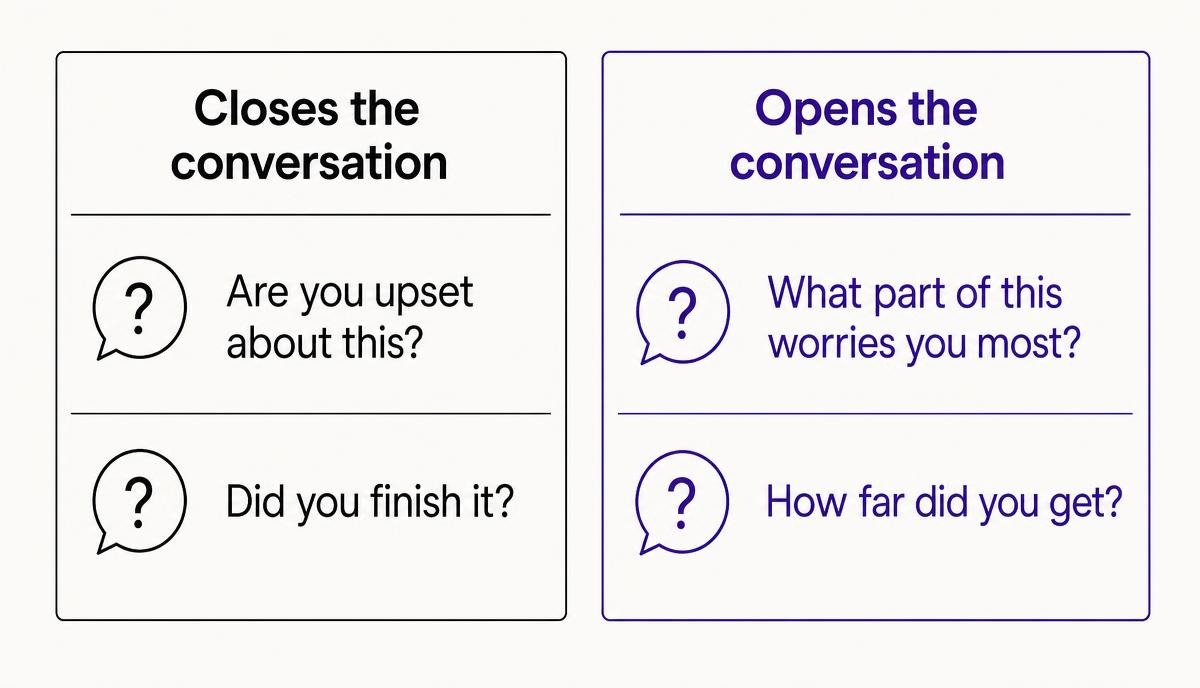
Questions that open versus questions that close
The quality of your questions determines how much there is to listen to. Clarifying questions expand the picture; loaded questions collapse it into a verdict on your existing theory.
| Instead of | Try | Why it works better |
|---|---|---|
| Don't you think we should just delay it? | What are the options you've considered? | Removes the embedded answer, so the reply is information rather than agreement |
| Why did you do it that way? | What led you to that approach? | Asks for reasoning without the accusation "why" often carries |
| Are you annoyed about the change? | How did the change land for you? | Avoids a yes/no the person will usually decline for politeness |
| Does that make sense? | What did you take away from that? | Tests understanding instead of inviting an automatic nod |
| Anything else? | What haven't we talked about that matters here? | Signals there is room for the harder item they were holding back |
| So you want more time, right? | What would need to be true for this to work? | Lets them define the need rather than confirming yours |
Notice that every improved version is open, non-evaluative and about their world rather than your hypothesis. That is the whole pattern. The same discipline of removing your own assumptions from a sentence is what makes writing clear, as covered in writing for clarity.
Listening when you disagree
Listening is easy when you have no stake. The skill only exists under disagreement, and the failure mode there is specific: you listen for the weak point rather than for the argument. You will find one — every argument has one — and the conversation becomes a search for something to refute rather than something to understand.
The counter-habit is to steelman before you respond. State their position in the strongest form you can, and get their agreement that you have it right, before you say a word against it. This costs about fifteen seconds and changes the temperature of the exchange completely, because people stop defending a position once they are satisfied it has been received.
Reflecting a point back is also not agreeing with it. "You think the deadline is the real risk, not the scope" is a summary, not a concession, and saying so explicitly — "I want to make sure I have your view before I give mine" — prevents the misunderstanding. This is a load-bearing skill in navigating difficult conversations.
Listening in writing
Most workplace listening now happens in text, where the loop still applies but the cues do not. In a thread, active listening looks like answering the question that was asked before adding your own, quoting the specific line you are responding to, and opening a reply with a one-sentence summary of the other person's point when the thread has become tangled.
It also means reading for the request rather than the mood. A message that reads as terse may simply have been written on a phone between meetings; assuming an attitude and responding to it produces a conflict that did not exist a minute earlier. The pattern is the negativity bias described in the psychology of digital messaging, and the fix is to respond to the words and ask about the rest.
A note on note-taking
Typing while someone speaks can look like inattention on video, where the other person cannot see your screen. Say what you are doing — "I'm taking notes, not disappearing" — and put the visible cues to work as described in body language in the digital age.
Practising without making it obvious
- Pick one conversation a day and commit to reflecting the other person's point once before you state yours.
- Count to two after they finish before you speak. That pause alone eliminates most rehearsing.
- End meetings you run with a spoken summary of what you heard and what was decided, then invite corrections.
- In writing, quote the exact line you are answering rather than replying to the message as a whole.
- When you notice you are formulating a rebuttal, ask a question instead and see where the extra minute goes.
Frequently asked questions
Is active listening the same as agreeing?
No. Reflecting a point accurately shows you have received it; you can then disagree with it clearly. Separating the two — first understand, then respond — usually makes the disagreement easier for both people, because nobody is arguing about whether they were heard.
Doesn't paraphrasing sound robotic?
It does when it is formulaic — "What I'm hearing is…" every time. Vary it, keep it short, and phrase it as a genuine check rather than a technique: "So the issue is the handover, not the timeline?" Nobody experiences that as scripted.
How do I listen well when I am short on time?
Set the boundary at the start instead of half-listening throughout: "I have ten minutes and I want to give you them properly — what is the most important part?" Ten attentive minutes are worth more to the other person than thirty distracted ones, and stating the limit is assertive rather than dismissive.
What if the other person will not stop talking?
Use a summary as the interruption. Reflecting their point back is the least abrasive way to take a turn, because it proves you were listening while also creating a natural break: "Let me check I have this — the concern is cost, and the timeline is secondary. Can I respond to the cost part?"
Related Articles
How to Set Boundaries at Work (Without Sounding Difficult)
A practical guide to setting boundaries at work: the four kinds of limits worth defining, the sentences that hold them, how to handle pushback, and what to do when the boundary keeps getting crossed.
What Does ")" Mean in Chat? The Bracket Smiley, Explained
A lone ")" at the end of a message is a smiley with the eyes left off — and a strong signal you are talking to someone from Eastern Europe. Here is what it means, why it exists, and how to read it correctly.
How to Ask for a Raise by Email (Templates and Scripts)
A practical guide to writing the email that asks for a raise: when to send it, what evidence belongs in it, three templates you can adapt, and the wording that keeps the tone confident rather than apologetic.