
How to Ask for a Raise by Email (Templates and Scripts)
A practical guide to writing the email that asks for a raise: when to send it, what evidence belongs in it, three templates you can adapt, and the wording that keeps the tone confident rather than apologetic.
Asking for a raise by email feels safer than asking in person, and it has one real advantage: you get to choose every word. It also has one real risk — nothing softens a badly framed sentence when there is no tone of voice attached to it. A raise email works when it is short, specific, unapologetic, and ends with a request for a conversation rather than a demand for a number.
This guide covers the timing, the structure, the evidence to include, and three templates for the situations most people are actually in. If you want the broader groundwork on asking for things directly, start with our guide to passive, assertive and aggressive communication.
Should you ask by email at all?
Email is the right channel for one of two jobs: opening the conversation, or confirming one you already had. It is the wrong channel for the negotiation itself. A manager reading a full salary argument cold, with no chance to ask questions, will almost always default to "let me think about it" — which is where requests go to die.
So use the email to book the meeting and to put your case on the record in writing. That gives your manager something concrete to take to their own manager or to HR, which is usually where the decision actually gets made.
When to send it
Timing changes the answer more than wording does. The best moment is when your value is visible and the budget is still unallocated — which in most companies means six to eight weeks before the annual or half-year review cycle closes, not the week after it does.
| Situation | Send now? | Why |
|---|---|---|
| You just delivered a visible, measurable win | Yes | Your contribution is fresh and easy to point at |
| Budget planning starts in 1–2 months | Yes | Numbers are still being decided |
| Your scope grew — new reports, new system, new accounts | Yes | The job changed; the pay should be reviewed |
| A round of layoffs or a hiring freeze just happened | Wait | No budget exists to say yes with |
| Your last review was under three months ago | Wait | Ask for a mid-cycle checkpoint instead |
| You are mid-way through a project that is going badly | Wait | The conversation gets attached to the problem |

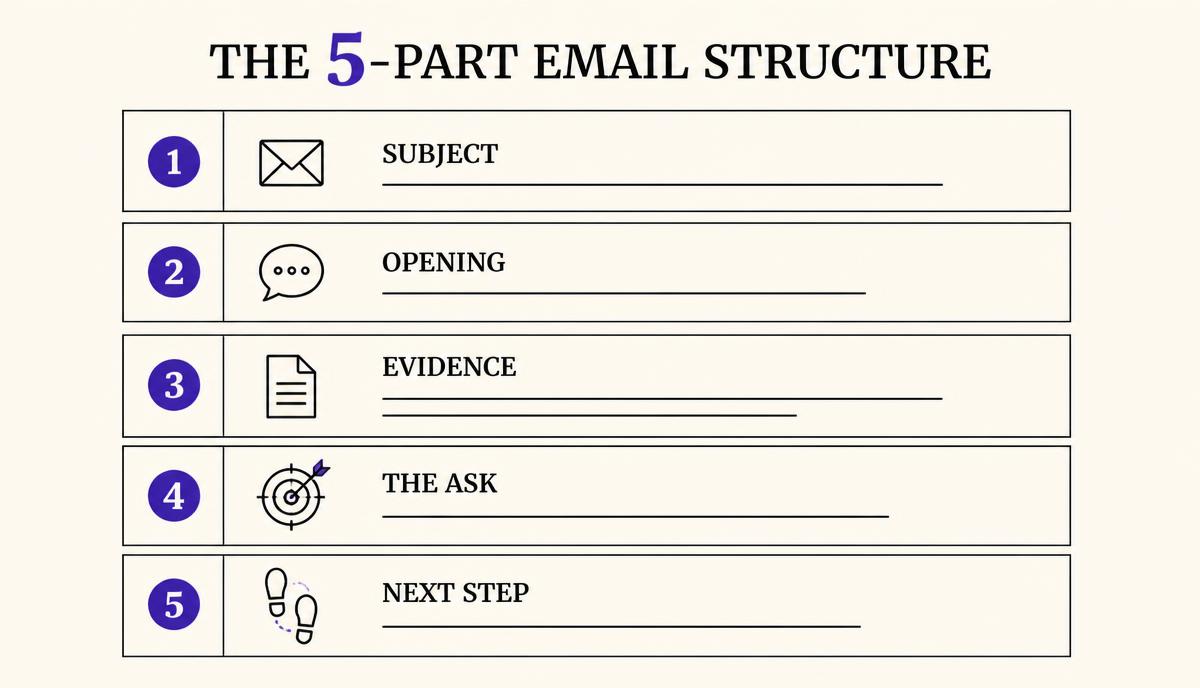
The five parts of the email
- Subject line — plain and specific. "Salary review — 20 minutes?" beats "Quick question". See our notes on writing subject lines that get opened.
- Opening — one sentence naming the purpose. No preamble about how busy everyone is.
- Evidence — two or three concrete contributions, with numbers or named outcomes.
- The ask — the request itself: a review of your compensation, and a figure or range if you have one.
- Next step — a proposed time to talk, so the reply is a calendar answer rather than a decision.
Keep the whole thing under 200 words. Length reads as anxiety, and anxiety invites a delay. Our guide to simplifying complex ideas covers the trimming technique if your draft keeps growing.
Template 1: Opening the conversation
Use this when nothing has been discussed yet and you want a meeting on the calendar.
Subject: Salary review — 20 minutes this week?

Hi [Name],

I would like to talk about my compensation, and I wanted to give you
the context in advance.

Over the past year I have taken on [specific scope change], led
[project] which [measurable outcome], and become the main point of
contact for [area]. That is meaningfully more than the role I was
hired into.

Based on that and on market rates for the role, I would like to
discuss moving my salary to [figure or range].

Could we find 20 minutes this week or next? Happy to work around
your calendar.

Thanks,
[Your name]
Template 2: After your scope has grown
Use this when the job itself has changed — new responsibilities, new reports, a departed colleague’s workload absorbed.
Subject: Reviewing my role and compensation

Hi [Name],

Since [month], my role has expanded to include [responsibility one]
and [responsibility two], and I have been covering [area] since
[colleague] left.

The work is going well and I want to keep doing it. I would like
my title and salary to reflect the current scope, and I think
[figure or range] matches what this role is now.

Can we put 30 minutes aside to go through it? I can share a short
summary of the added scope beforehand if that helps.

Thanks,
[Your name]
Template 3: Following up after a verbal conversation
Use this immediately after a meeting, while it is still fresh. This is the email that stops a positive conversation from quietly evaporating.
Subject: Following up on our salary conversation

Hi [Name],

Thanks for the conversation on [day]. To summarise what I understood:

- You are supportive of an adjustment in principle
- The decision sits with [person or process]
- The next budget checkpoint is [date]

My request is [figure or range], based on [scope change] and
[market reference].

What would be most useful from me before [date]? I am happy to put
together anything that makes the case easier to take forward.

Thanks,
[Your name]
Wording that weakens the ask
Most raise emails fail on hedging rather than content. Each of these phrases sounds polite and quietly tells the reader the request is optional.
| Instead of | Write | Why it works |
|---|---|---|
| "I hate to bring this up, but…" | "I would like to discuss my compensation." | Removes the apology for a normal request |
| "I was just wondering if maybe…" | "I am asking for a review of my salary." | States the ask once, clearly |
| "I feel like I have done a lot" | "I led X, which delivered Y." | Replaces feeling with evidence |
| "Whatever you think is fair" | "I am asking for [figure]." | Anchors the number on your side |
| "If it is not possible I completely understand" | "If now is not the right time, when is?" | Keeps the conversation open instead of closing it |
| "Sorry for the long email" | (delete) | Apologising for your own message undercuts it |
One more: do not justify the request with personal need — rent, a mortgage, a new baby. It is sympathetic and it is the wrong frame. Compensation conversations are settled on contribution and market rate. If the email is likely to be a tense one, our guide to navigating difficult conversations covers holding your position without escalating.
What to do with the answer
A yes should be confirmed in writing the same day, including the amount and the effective date. A "not now" should be converted into something dated: what needs to be true, and when it will be revisited. A flat no with no path attached is real information about the role, and worth taking seriously.
The one response to avoid is silence on your side. Requests that are never followed up read, in hindsight, as requests that were never serious. Booking the checkpoint is part of the ask, not a separate favour — the same principle as holding a boundary after you have set it.
Frequently asked questions
Should I name a number in the email?
Yes, if you have a defensible one. Naming a figure or a narrow range anchors the discussion where you want it and saves a round trip. If you genuinely do not know the market rate yet, ask for the review and bring the number to the meeting instead — but do not leave it open indefinitely.
How much should I ask for?
For a raise within the same role, a 5–10% adjustment is normal territory. Where your scope or title has genuinely changed, the relevant comparison is the market rate for the new role, which can be considerably more. Cite the basis for the number — a job posting, an industry salary survey, an internal band — rather than the number alone.
Is it unprofessional to ask by email?
No. Sending the request in writing gives your manager time to prepare and creates a record — both of which usually help you. What reads as unprofessional is a long, emotional, or ultimatum-shaped email, not the channel itself. See our email etiquette guide for the surrounding conventions.
Should I CC HR?
Not on the first email. Go to your manager first; CCing HR at the outset reads as escalation and puts your manager on the defensive. HR enters the thread when your manager brings them in, or later if the process stalls entirely.
What if I get no reply?
Follow up once after five working days, in the same thread, with two sentences: repeat the request and offer two specific time slots. If a second follow-up also goes unanswered, raise it verbally in your next one-to-one — persistent silence on a written request is usually about avoidance rather than about you.
Can I mention another job offer?
Only if it is real and you would actually take it. Used as leverage it works once, and it permanently changes how your commitment is read. A case built on your contribution ages much better than one built on a threat.
Related Articles

How to Set Boundaries at Work (Without Sounding Difficult)
A practical guide to setting boundaries at work: the four kinds of limits worth defining, the sentences that hold them, how to handle pushback, and what to do when the boundary keeps getting crossed.

How to Say No at Work Without Guilt
A practical script for declining requests clearly, kindly and without damaging the relationship

Professional Email Etiquette: A Practical Guide
How to write professional emails that stay warm, clear and respectful — from subject line to sign-off