
Professional Email Etiquette: A Practical Guide

How to write professional emails that stay warm, clear and respectful — from subject line to sign-off
Email etiquette is the set of habits that make a written message easy to read, easy to answer and hard to misread. Email strips out voice, face and timing, so the same sentence can land as efficient or as cold depending on a handful of small choices. This guide walks through those choices in the order you actually make them: subject, greeting, request, tone, detail, sign-off and reply.
Why email etiquette still matters
Most people receive far more email than they can read carefully. What they do instead is triage: scan the sender, scan the subject, open, look for a verb aimed at them, decide whether to act now, later or never. Etiquette is not politeness theatre; it is the practice of writing messages that survive that process intact.
There is a second reason. Email is the channel of record. Chat disappears, calls are unminuted, but email is forwarded, quoted and re-read months later by people who were not in the original conversation. A message that reads as sharp today can read as hostile out of context tomorrow. Writing with that audience in mind is not paranoia — it is the same discipline that underpins professional communication generally.
Start with the subject line
A professional subject line names the topic and the action. "Budget review — need your numbers by Friday" tells the reader more in seven words than "Quick question" ever will. Vague subjects do not save the writer time; they move the cost onto the reader, who must open the message to learn whether it can wait.
Two habits help. Put the deadline in the subject when there is one, and start a new thread when the topic changes rather than replying to a six-week-old chain about something else. If subject lines are a recurring weak point, the longer breakdown of how to write subject lines that get replies covers the patterns in detail.
Greetings and register
Open with a greeting that fits the relationship. "Hi Sarah," is safe in most workplaces. "Dear Ms. Novak," suits a first contact with a client, a regulator or an institution. Dropping the greeting entirely reads as brusque to many recipients, and noticeably so across cultures where the opening line carries real social weight.
Register is not a fixed setting you choose once. It moves with the reader, the topic and the stakes. Internal chat with a teammate can be clipped; an email to a client about a missed deadline cannot. Teams that work across regions run into this constantly, which is why it is worth understanding how cultural expectations shape communication before assuming your default is neutral.
Put the request in the first two sentences
State what you need, then supply the context underneath it. The instinct to build up to the ask — background, rationale, then finally the question — comes from spoken conversation, where the listener cannot skip ahead. In email the reader can and will. Burying the request means it gets missed, and a missed request becomes a chase, and a chase becomes friction that neither party remembers signing up for.
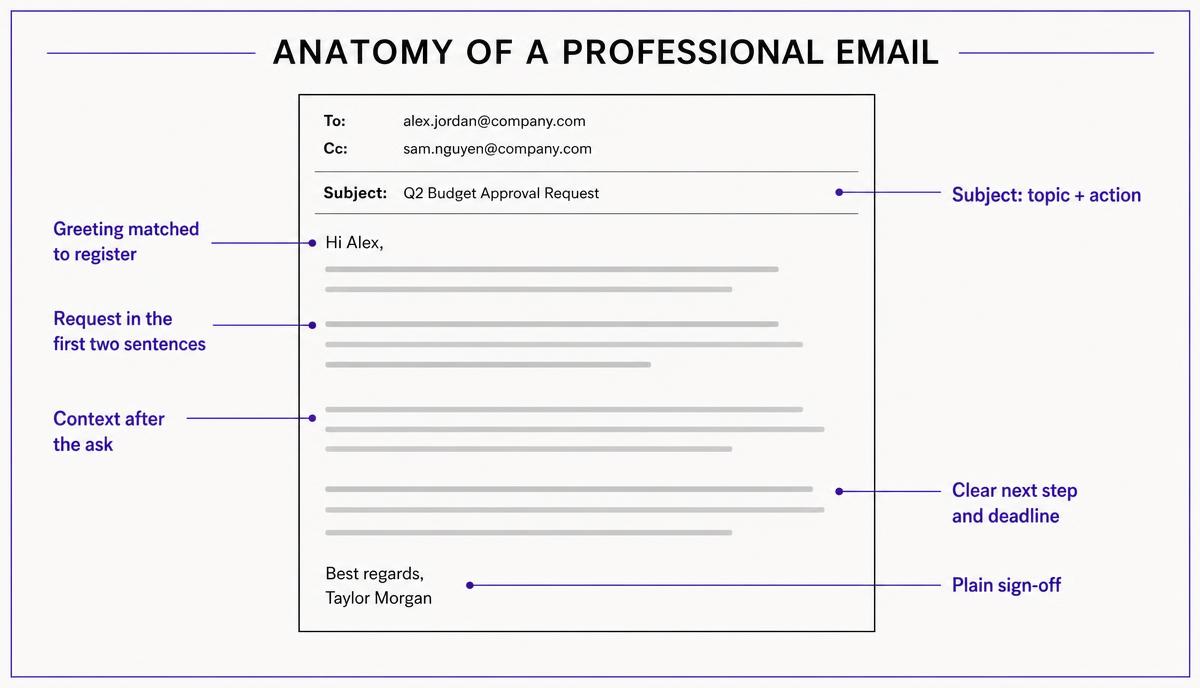
If the email contains more than one request, use a short list so nothing is lost:
- One line per request, each starting with the verb the reader must perform.
- A named owner if more than one person is on the thread — "Sam: the invoice" beats hoping someone volunteers.
- A date against anything time-bound, written out rather than "ASAP".
- A closing line stating what happens if you hear nothing, so silence has a defined meaning.
Tone: the assertive middle
Hedging language makes a reasonable request sound apologetic. Blunt imperatives make the same request sound like an order. The assertive middle states the need plainly and acknowledges the other person's workload, and it is the register that keeps relationships intact over hundreds of small exchanges. The mechanics of all three registers are set out in the comparison of passive, assertive and aggressive styles.
The table below shows how the same email element changes meaning depending on how it is written.
| Element | Reads as cold | Reads as apologetic | Assertive version |
|---|---|---|---|
| Subject | Numbers | Sorry — quick question if you have a sec | Q3 figures — needed by Friday |
| Opening | As discussed. | So sorry to bother you again about this! | Hi Sarah — following up on the Q3 figures. |
| The ask | Send the figures. | I was just wondering if maybe you could possibly send them? | Could you send the figures by Friday? |
| Deadline | Needed ASAP. | Whenever you get a chance, no rush at all | Friday 3pm works — tell me if that is tight. |
| Sign-off | Thanks. | Thanks so much, sorry again! | Thanks — Ana |
Notice that the assertive column is barely longer than the cold one. Warmth in email comes from specificity and from leaving room to reply, not from padding.
The details that quietly signal care
Spell the recipient's name correctly, every time. Avoid all-caps, which reads as shouting to almost everyone. Keep exclamation marks sparing — one can warm a line, three make an adult sound anxious. Emoji are fine in internal chat with people you know and out of place in a first client email or anything involving money, contracts or performance.
Reply-all only when every recipient genuinely needs the answer. Use BCC to protect addresses when emailing a list of people who do not know each other, and never to quietly loop in a third party mid-argument. Attach the file before you write the sentence that mentions it. Sign off with your name; automated signatures alone can read as machine-generated.
The forwarding test: before sending anything sensitive, ask whether you would be comfortable if this email were forwarded to the person it describes. If not, rewrite it until you would be.
Length, structure and skimmability
Aim for something a reader can finish on one phone screen — roughly 100 to 150 words. When the topic genuinely needs more, do not compress it into dense prose. Put the request and the deadline at the top, then add detail below under short headings or bullets so the reader can choose their own depth. Long emails are not the problem; undifferentiated ones are.
Technical content deserves particular care, because the writer usually knows too much to notice what is missing for the reader. The habits in writing for clarity apply directly: define the term the first time, use one example, and cut the sentence that only exists to prove you understand the subject.
Response times and holding replies
Respond within one business day even when you cannot give a full answer. A two-line holding reply — "Got this, I need until Thursday to give you a proper answer" — removes the single most common source of email friction, which is not disagreement but silence. Silence gets interpreted, and it is rarely interpreted generously.
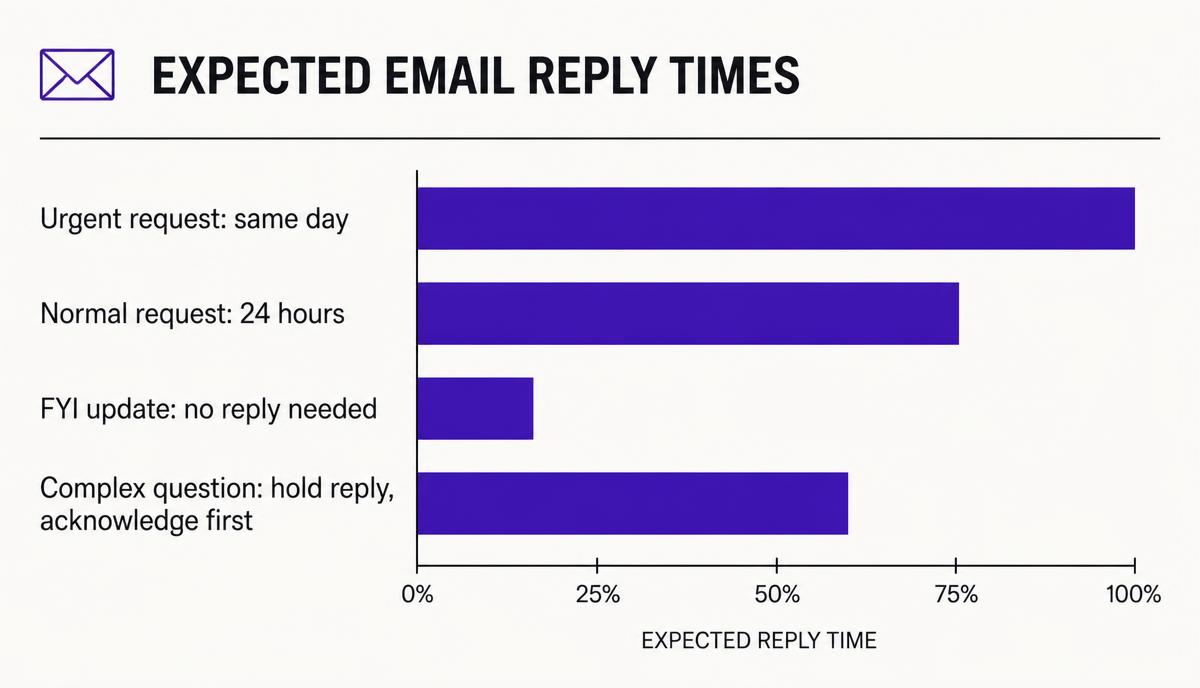
If you are the one waiting, follow up once in the same thread, restate the ask in a single line and give a new date. Assume the message was missed rather than ignored. If a second attempt also goes unanswered, change channel — a two-minute call resolves what a fourth email will not.
When email is the wrong choice
Etiquette includes knowing when not to send. Email is poor at disagreement, poor at emotional weight and poor at anything that will take three rounds of writing to resolve. Bad news delivered by email is usually a way of avoiding the discomfort of delivering it, and recipients can tell. If the message has heat in it, the structure in navigating difficult conversations will serve you better than another draft.
Reread before sending, ideally out loud. If a sentence sounds sharper than intended, soften the verb rather than adding apologies. That single pass catches most tone problems — and it is the pass SpeakWise automates: paste a draft, and it flags passive, aggressive and passive-aggressive phrasing, then shows the assertive rewrite. The feature list explains what it checks.
Frequently asked questions
How formal should a work email be?
Match the reader, not a template. Internal colleagues you speak with daily need a greeting, a clear ask and a name at the end. External contacts, first approaches and anything contractual warrant a fuller greeting and no contractions or slang. When unsure, start one step more formal and relax as the thread continues.
Is it rude to send an email without a greeting?
In a fast-moving internal thread where you are already mid-conversation, no. As the opening message of a thread, or with anyone outside your team, yes — it reads as abrupt. A two-word greeting costs nothing and prevents the reader from filling in a tone you did not intend.
How do I chase someone without sounding pushy?
Keep it short, neutral and forward-looking. "Hi Sam — checking in on the figures from last week. Could you send them by Thursday, or tell me if the timing is difficult?" No sarcasm, no "as per my previous email", no timestamp of when you first asked. The neutral chase almost always outperforms the pointed one.
Should I apologise for a delayed reply?
One short line is enough: "Sorry for the slow reply." Then answer. Extended apologies shift the reader's attention onto your guilt instead of their question, and they make a normal delay look like a serious failure.
Related Articles
How to Set Boundaries at Work (Without Sounding Difficult)
A practical guide to setting boundaries at work: the four kinds of limits worth defining, the sentences that hold them, how to handle pushback, and what to do when the boundary keeps getting crossed.
How to Ask for a Raise by Email (Templates and Scripts)
A practical guide to writing the email that asks for a raise: when to send it, what evidence belongs in it, three templates you can adapt, and the wording that keeps the tone confident rather than apologetic.

How to Say No at Work Without Guilt
A practical script for declining requests clearly, kindly and without damaging the relationship