
How to Set Boundaries at Work (Without Sounding Difficult)

A practical guide to setting boundaries at work: the four kinds of limits worth defining, the sentences that hold them, how to handle pushback, and what to do when the boundary keeps getting crossed.
Setting boundaries at work is mostly a communication problem, not a courage problem. Most people already know which parts of their week are unsustainable. What they lack is a sentence that states the limit plainly, without an apology in front of it and without an argument attached to the end. That sentence is the whole skill.
This guide covers the four kinds of workplace boundary worth defining, exact wording for each, how to answer the pushback you should expect, and what to do when a limit keeps being ignored. If your immediate problem is a specific request you need to turn down, start with our guide to saying no at work without guilt.
What a boundary at work actually is
A boundary is a statement about your own behaviour, not a rule you impose on someone else. "I do not check Slack after 19:00" is a boundary. "Stop messaging me in the evening" is a demand. The first one you can enforce entirely on your own; the second one depends on other people cooperating, which is why it usually fails and why it lands badly.
That distinction matters for tone as well as effectiveness. Boundaries phrased as descriptions of what you do sound calm and factual. The same limit phrased as an instruction sounds like a complaint, and colleagues respond to the framing rather than the substance.
The other thing to accept early: a boundary is not a negotiation you win once. It is a position you restate, briefly and without escalation, until it becomes the way people expect to work with you. The restating is normal, not a sign that you failed.
The four boundaries worth defining
Almost every workplace friction traces back to one of four limits being undefined. Naming which one is under strain tells you what to say.

| Boundary type | What it protects | Typical breach | A sentence that holds it |
|---|---|---|---|
| Time | Focus blocks and finishing hour | Meetings booked over deep work | "I keep 9–11 clear for delivery work — anything after 11 works." |
| Workload | Capacity and quality | A new priority with nothing removed | "I can take that on if we move the report to next week. Which would you prefer?" |
| Availability | Evenings, weekends, leave | Evening messages expecting replies | "I pick messages up from 09:00. If something is urgent overnight, call." |
| Channel | Attention and record-keeping | Decisions made in scattered DMs | "Can we keep decisions on this in the project thread so it stays findable?" |
How to phrase a boundary so it holds
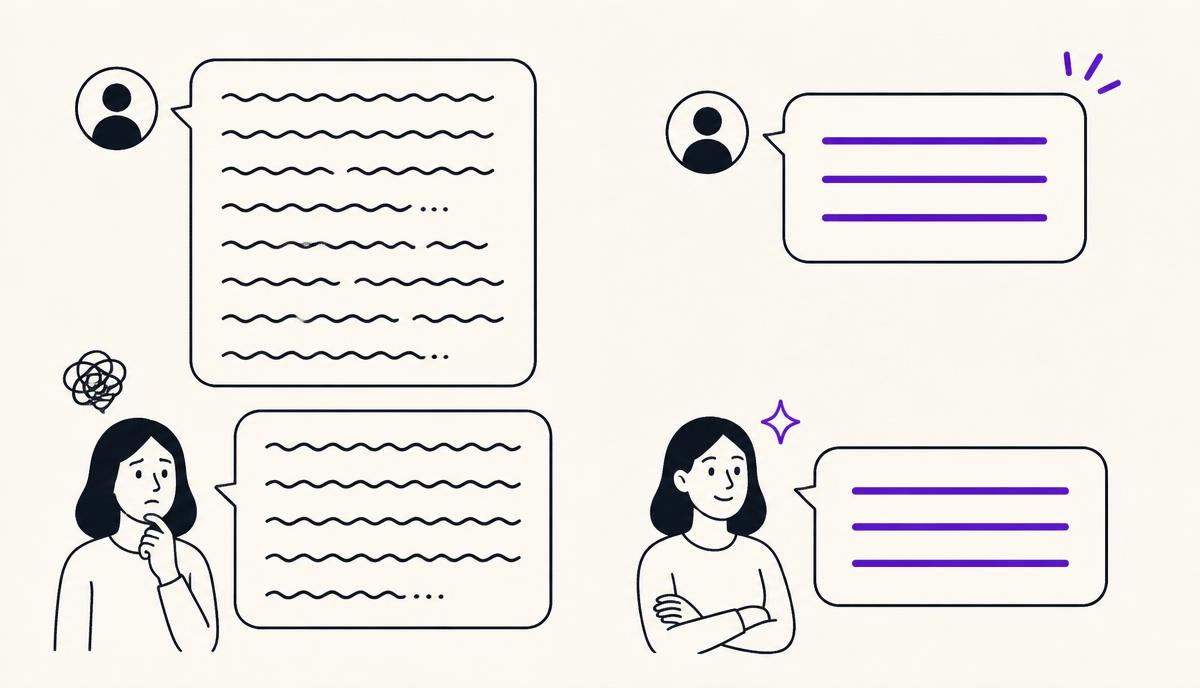
A durable boundary sentence has three parts and no fourth. State the limit, give one line of context if it genuinely helps, and offer what you can do instead. Then stop. The most common mistake is a fourth part — the justification — which invites the other person to argue with your reasons instead of accepting the limit.
- The limit, in the first sentence: "I can't take a fourth project this sprint."
- One line of context, optional: "The migration is due Thursday and it is fully booked."
- The alternative: "I can pick it up from Monday, or Priya has capacity now."
Notice what is absent: no apology, no "sorry to be difficult", no explanation of how tired you are. Those additions read as an invitation to overrule you. Our guide to passive, assertive and aggressive communication covers why the middle register is the one that actually gets respected.
Wording that undermines the boundary
Most boundaries fail in the phrasing rather than the principle. These are the substitutions worth making.
| Weak version | Why it fails | Stronger version |
|---|---|---|
| "Sorry, I'm a bit swamped, but I'll try to fit it in." | Signals the limit is negotiable and commits you anyway | "I can't fit this in this week. I can start Monday." |
| "I'll probably be offline later, hopefully that's okay?" | Asks permission for something that is yours to decide | "I'm offline from 18:00 and will reply in the morning." |
| "I feel like I always get these last minute." | Reads as a grievance about the past, not a limit going forward | "For requests like this I need two working days' notice." |
| "Whatever works for everyone else is fine by me." | Removes your constraint from the decision entirely | "Any slot after 11:00 works for me." |
Handling the pushback
Expect one round of resistance. It is rarely hostile; it is usually someone reflexively testing whether the limit is real. The technique that works is repetition without escalation: restate the same sentence, slightly shorter, without adding new reasons.
- "But this is urgent." — "I understand. I still can't start before Monday. If it can't wait, it needs to go to someone else."
- "Everyone else is flexible about evenings." — "I reply from 09:00. Call me if something genuinely can't wait."
- "It'll only take an hour." — "An hour I don't have this week. Monday morning I do."
- "I thought you were a team player." — "I am, which is why I'd rather be honest about capacity than miss a deadline quietly."
The temptation at this point is to add a new justification. Don't. Each new reason gives the other person another thing to dismantle, and the conversation drifts from your limit to the merits of your excuses. For higher-stakes versions of this exchange, see navigating difficult conversations.
Boundaries with your manager, peers and reports
The sentence changes depending on who holds the power in the exchange. With a manager, frame the boundary as a prioritisation question rather than a refusal: "I can do A or B by Friday, not both — which matters more?" That hands the decision back where it belongs and is almost impossible to read as obstruction.
With peers, be concrete about the mechanism rather than the feeling: "Send design requests in the shared channel rather than DMs, so they don't get lost when I'm heads-down." With people who report to you, state the limit and then model it — a manager who declares an evening cut-off and then sends 22:00 messages has just taught the team that the stated boundary is decorative.
Cross-cultural teams add another layer: directness that reads as healthy in Amsterdam can read as abrupt in Tokyo or São Paulo. The limit stays the same; the packaging shifts. Our guide to cultural differences in communication covers where those thresholds sit.
When the boundary keeps getting crossed
If the same limit is breached repeatedly by the same person, stop restating and change the register once. Move from the individual instance to the pattern, in writing: "Over the last month I've had four requests arriving after 18:00 marked urgent. I want to agree how we handle genuinely urgent work, because replying to all of them isn't sustainable."
Naming the pattern with a count is far harder to wave away than another individual no, and it converts a series of small refusals into one process conversation. If nothing changes after that, the issue is no longer your phrasing — it is a workload or management problem that needs your manager or HR involved, and it belongs on the record.
If you want to check how a boundary message reads before you send it, paste it into SpeakWise — it will tell you whether the tone lands as assertive or apologetic and offer a tighter rewrite.
Frequently asked questions
How do I set boundaries at work without sounding difficult?
State the limit as a fact about your own working pattern, keep it to one or two sentences, and pair it with something you can do instead. Difficulty is almost never about the limit itself — it comes across when the limit arrives with irritation, a list of grievances, or an implied accusation.
Should I explain why I'm setting a boundary?
One line of context if it helps the other person plan; nothing beyond that. Long explanations read as a case being argued, which signals the decision is still open. "I'm at capacity this week" is enough — you do not owe a full accounting of your calendar.
What if my boss ignores my boundaries?
Shift from refusing individual requests to a prioritisation conversation: list what is currently on your plate, ask which item should move, and put the answer in writing. If the pattern continues after that, document the instances with dates and raise it as a workload issue rather than a personality one.
How do I set boundaries around after-hours messages?
Announce your availability window once, then enforce it by behaviour rather than by argument. The evening message you answer at 22:30 teaches people more than any policy statement. Give one escape hatch — a phone call for genuine emergencies — so the boundary is clearly about attention, not availability in a crisis.
Is it too late to set boundaries in a job I've had for years?
No, but name the change rather than letting it appear as sudden moodiness: "I've been saying yes to more than I can deliver well, so I'm going to be stricter about capacity from now on." Framing it as a quality decision rather than a withdrawal makes it much easier for colleagues to absorb.
What is the difference between a boundary and being uncooperative?
A boundary always includes an alternative — a different time, a different scope, a different person. Uncooperativeness ends at the refusal. If your message names what you can do alongside what you can't, it reads as professional judgment about capacity, which is exactly what it is.
Related Articles

How to Ask for a Raise by Email (Templates and Scripts)
A practical guide to writing the email that asks for a raise: when to send it, what evidence belongs in it, three templates you can adapt, and the wording that keeps the tone confident rather than apologetic.

How to Say No at Work Without Guilt
A practical script for declining requests clearly, kindly and without damaging the relationship

Professional Email Etiquette: A Practical Guide
How to write professional emails that stay warm, clear and respectful — from subject line to sign-off