
Navigating Difficult Conversations

A practical framework for raising hard topics at work: how to prepare, open, hold your position under pressure, and close with something that actually changes.
A difficult conversation goes well when you name the issue plainly in the first thirty seconds, describe its effect without assigning motives, and then stop talking long enough to hear the other side. Most of the pain people associate with these conversations comes from the two failure modes around that: avoiding the topic until it hardens, or arriving with a verdict already written.
Why these conversations feel so costly
A conversation becomes difficult when three things are true at once: something concrete is at stake, the two people see the situation differently, and at least one of them expects an emotional reaction. Any one of those alone is manageable. Together they trigger the instinct to postpone, and postponement is what turns a small correction into a grievance.
Delay also changes the content. When you raise an issue the first time, it is a single event: a missed handover, a comment in a meeting. When you raise it after four months, it is a pattern, and patterns feel like character judgements to the person receiving them. The conversation you were avoiding was easy compared with the one you now have to have.
It is worth being honest about the other reason for delay: the hope that the problem resolves itself. Occasionally it does. Far more often the other person has no idea anything is wrong, because nobody told them, and they continue doing the thing you find intolerable in good faith.
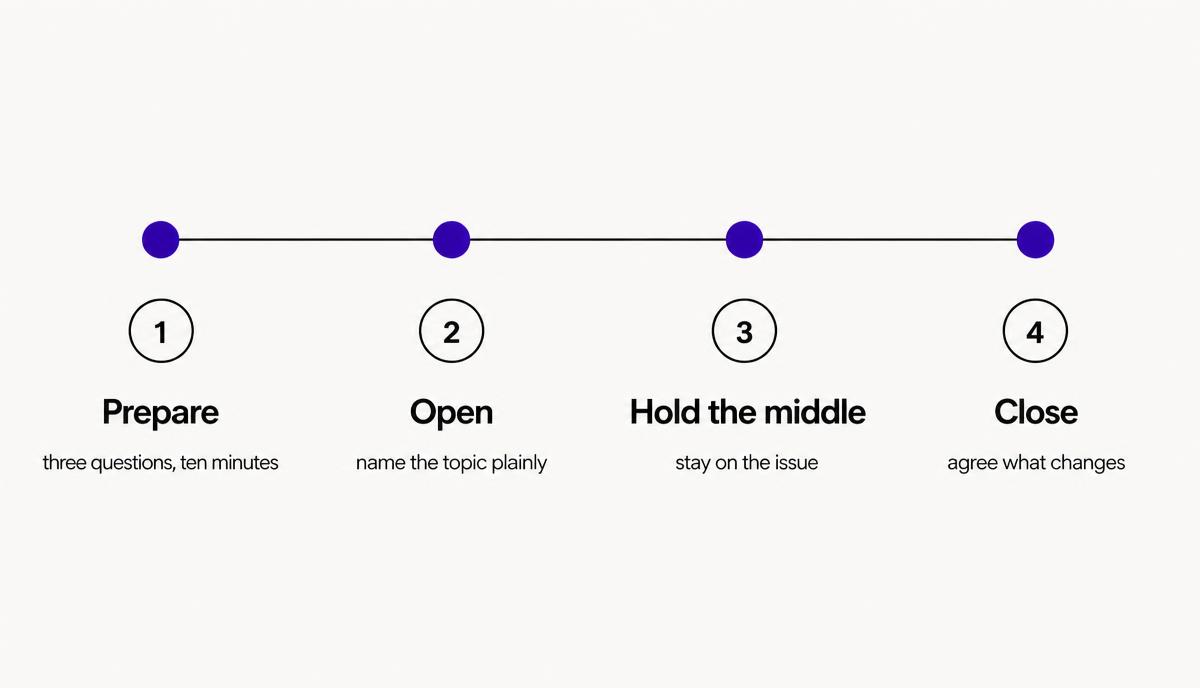
Preparation: three questions, ten minutes
Preparation is not scripting the whole exchange — that produces a performance that collapses the moment the other person says something unexpected. It is settling three things in advance so that you cannot be knocked off them.
What actually happened?
Separate the observable facts from the story you have built around them. "The report arrived two days after the deadline, twice this month" is a fact. "You do not take my deadlines seriously" is a story. Both may feel equally true, but only one of them survives contact with the other person. Write the facts down; you will need them when the conversation gets warm.
What is the effect?
Name the concrete cost, to the work or to you. "It means I review it at midnight" or "The client asked twice and I had nothing to give them." Effects are hard to argue with because they are yours to report. Without an effect, a complaint sounds like a preference, and preferences are easy to decline.
What do you want to be different?
If you cannot finish the sentence "after this conversation, I would like…", do not have the conversation yet. A specific, small, checkable request — "send it Wednesday, or tell me on Tuesday if it will slip" — gives the exchange somewhere to land. Vague requests to be more communicative or more considerate produce agreement and no change.
Opening the conversation
The first two sentences set the register for everything after. Say why you are there and what you want the conversation to achieve, then hand over. "I want to talk about the handover process, because it has slipped twice and I have been picking it up late. I would like us to agree on something that works for both of us — but first I want to hear how it looks from your side."
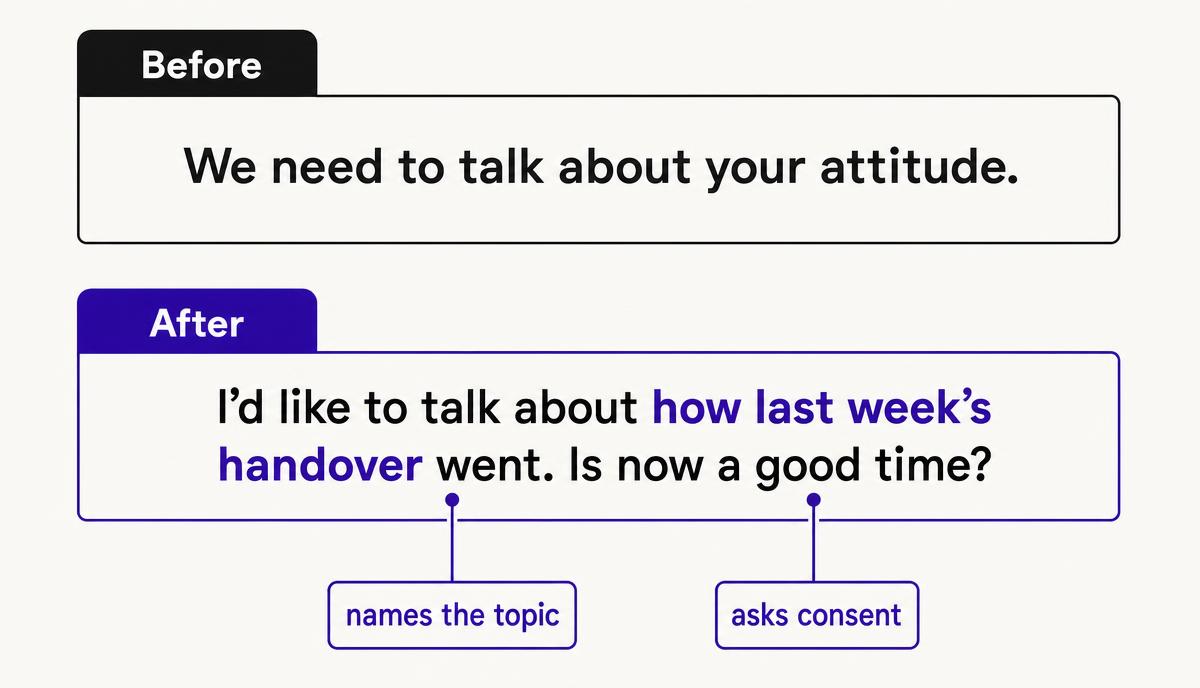
Two common openings do damage before the topic is even reached. The first is the compliment sandwich, which teaches people to distrust your praise and often obscures the point so thoroughly that they leave without realising anything was wrong. The second is the long preamble, which gives the other person several minutes to work out that bad news is coming and to prepare a defence for something they have not heard yet.
Getting the register right — clear without being combative — is the whole skill, and it is the same distinction covered in passive vs. assertive vs. aggressive.
Phrasings that change the outcome
Difficult conversations turn on small wording choices, because each one either invites a defence or invites an answer. The table below shows the common reflexes and what to say instead.
| Reflex phrasing | What the other person hears | Better phrasing |
|---|---|---|
| You always miss deadlines. | A verdict on my character that I need to disprove. | The last two reports came in after the date we agreed. |
| You clearly don't care about this. | You have decided what I think and are telling me about it. | I could not tell how much priority this had for you — where does it sit? |
| We need to talk. | Something bad is happening and I have no idea how bad. | I want to go through the handover process with you for fifteen minutes. |
| I'm sorry to bring this up, it's probably nothing… | This does not matter, so I can safely dismiss it. | There is something I need to raise, and I want to get it sorted today. |
| Everyone has noticed it. | I am outnumbered and being ambushed. | This is my own observation, and I may be missing context. |
| You made me look bad. | I am being blamed for your feelings. | When the numbers did not match in the meeting, I could not answer the client. |
Holding the middle when it gets hot
Once the topic is on the table, your job shifts from stating to listening. This is where most well-prepared conversations fail: the other person responds, you hear an excuse rather than information, and you start arguing your case again. The reliable move is to reflect their position back before you say anything else, and to get their confirmation that you have it right. That single step, described more fully in the art of active listening, lowers the temperature more than any amount of careful phrasing.
Expect one of a few reactions and have a response ready for each.
- Defensiveness: agree with any part you honestly can, then restate the specific request. Arguing about whether they are defensive is a conversation you cannot win.
- Counter-attack: acknowledge the new topic and park it. "That is worth discussing and I will make time for it — can we finish this one first?"
- Tears or visible distress: pause, offer a break, and do not withdraw the substance. Softening the request in the moment is kind and undoes the entire conversation.
- Silence: leave it. Fill the gap and you will have answered your own question and let them off having to speak.
- Total agreement: slow down. Quick agreement is often the fastest route out of the room, so confirm the specifics — what, by when — before you close.
When you are wrong
Sometimes the other person's account makes it clear that you misread the situation. Say so directly and without a caveat: "I did not know about the approval delay. That changes how I see this." Reversing cleanly costs nothing and buys you enormous credibility the next time you raise something.
Closing so that something changes
A difficult conversation that ends with mutual goodwill and no agreement has to be repeated, usually in a worse mood. Before you leave, state the specific change, who does what, and when you will check in. Say it out loud even if it feels bureaucratic — "So: you send it Wednesday, and if it is going to slip you message me Tuesday. Let us see how that goes for a month."
Follow up in writing the same day with a short, neutral summary. Not a record for the file, and not a restatement of the criticism — three lines confirming what was agreed. This is also where tone risk reappears, because a written recap can read far colder than the conversation felt; the guidance in professional email etiquette applies directly.
Choosing the channel
Difficult conversations belong in the highest-bandwidth channel available: in person first, video second, phone third. Text is for scheduling them and confirming afterwards, never for holding them. Written words carry none of the warmth that makes hard content bearable, and the reader supplies a harsher tone than you intended — the mechanism described in the psychology of digital messaging.
Frequently asked questions
How do I start a difficult conversation with my boss?
Ask for a short slot with a stated topic — "Fifteen minutes this week about how the review workload is landing?" — so nobody walks in cold. Then open with the effect on the work rather than on your feelings, and bring one specific proposal. Managers respond to problems that arrive with a suggested fix attached.
What if the other person refuses to engage?
State the request once, clearly, and say what you will do in the absence of a response: "If the file is not there by Wednesday I will build the deck from last month's numbers and flag the gap." That is not a threat; it is telling them how you will proceed so nobody is surprised later.
Should I have the conversation while I am still angry?
No, but do not wait for the anger to disappear either, because that often means waiting forever. Wait until you can state the facts and the effect without editorialising — usually a few hours, sometimes a night. Any longer and the delay itself becomes part of the problem.
How do I handle this across cultures or seniority gaps?
Keep the clarity and adjust the packaging: more context, more relational framing, and a private setting where indirectness is the norm. The trade-offs are covered in cultural differences and communication. What should not change is the specific request at the centre.
Related Articles

How to Set Boundaries at Work (Without Sounding Difficult)
A practical guide to setting boundaries at work: the four kinds of limits worth defining, the sentences that hold them, how to handle pushback, and what to do when the boundary keeps getting crossed.
How to Ask for a Raise by Email (Templates and Scripts)
A practical guide to writing the email that asks for a raise: when to send it, what evidence belongs in it, three templates you can adapt, and the wording that keeps the tone confident rather than apologetic.

How to Say No at Work Without Guilt
A practical script for declining requests clearly, kindly and without damaging the relationship