The Psychology of Digital Messaging
Why written messages get misread, how tone gaps and negativity bias distort chat and email, and what to change so your intent survives the screen.
Digital messages get misread because readers supply the missing tone themselves, and under pressure they supply a negative one. Text removes voice, face and timing, so the reader fills those gaps with their own mood, their history with you, and whatever else is happening in their day. Writing well online is mostly about leaving fewer gaps to fill.
The tone gap: what text takes away
In person, meaning arrives through several channels at once. Words carry the content, while pitch, pace, facial expression and posture carry the attitude behind it. A flat sentence like "Fine, we can do that" can be resigned, cheerful or sarcastic, and in a room you know which one within a fraction of a second.
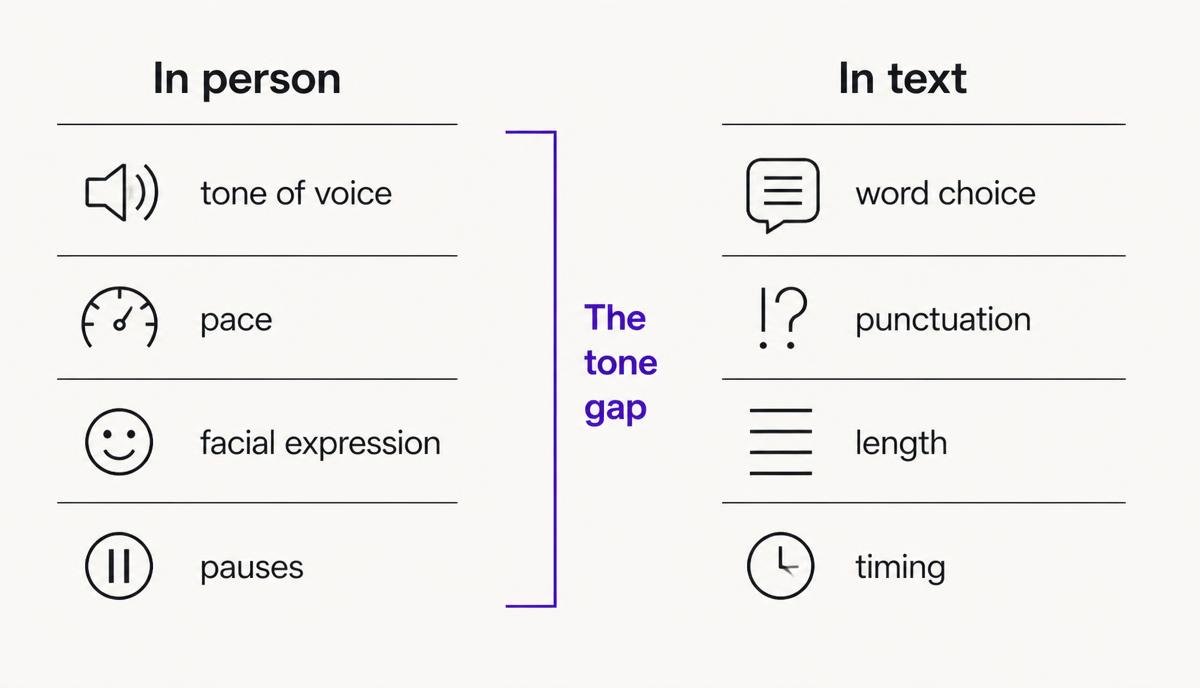
Strip those channels away and only the words remain. The reader still needs an attitude to attach to them, so they infer one. That inference is not neutral. It is shaped by their current state, by what happened in the last conversation you had, and by their assumptions about your status relative to theirs. This is why the same three-word reply can feel efficient from a peer and dismissive from a manager.
The gap widens further when people cannot see each other at all. Video restores part of the signal, which is why the cues discussed in reading body language in virtual meetings still matter even when everyone is remote. Pure text restores none of it.
Why readers default to the worst reading
Ambiguity is uncomfortable, and the mind resolves it quickly rather than accurately. Two tendencies do most of the damage in written communication.
Negativity bias
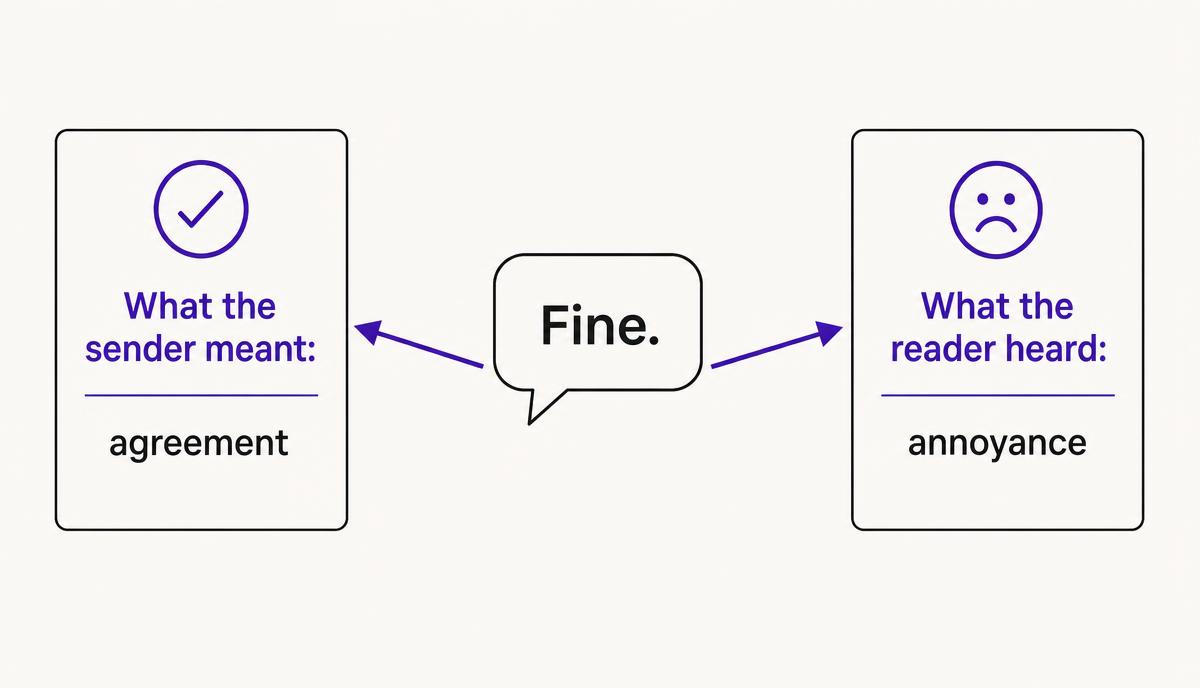
Threatening interpretations get attention first because, historically, missing a threat cost more than misreading a friendly remark. Applied to a message thread, that means a neutral sentence is read as mildly negative, and a mildly negative sentence is read as hostile. Brevity accelerates it: the shorter the message, the more room the reader has to fill, and the filling skews dark.
The transparency illusion
Writers systematically overestimate how clearly their intent comes through. You know you meant the message kindly, you can hear your own tone as you type, and so it feels obvious. The reader has none of that. This is the single most useful thing to internalise about digital communication: the version in your head is not the version on their screen.
Silence as a message
Response time carries meaning online whether you intend it to or not. A delay after a difficult exchange reads as displeasure even when it is only a full calendar. Because silence cannot be clarified, it is the cheapest thing to fix: a one-line holding reply removes an entire day of speculation.
The signals readers actually use
Without voice, readers latch onto surface features and treat them as tone markers. Most people are not conscious of doing this, but the effects are consistent enough to plan around.
| Feature in your message | Common reader inference | Lower-risk alternative |
|---|---|---|
| One-word replies ("Ok.", "Noted.") | Annoyance or dismissal, especially with a full stop. | Add three words of context: "Ok, that works for me." |
| ALL CAPS or multiple exclamation marks | Shouting, urgency, or loss of composure. | State the urgency plainly: "This one is time-critical." |
| Ellipses ("Sure...", "If you say so...") | Reluctance or unspoken criticism. | Say the reservation out loud, or drop the dots. |
| "Per my last email" / "As I mentioned" | Reprimand, regardless of intent. | Repeat the information without the pointer to who forgot. |
| Long delay, then a short answer | The topic, or the sender, was low priority. | Acknowledge the gap in one clause: "Sorry for the slow reply." |
| A question with no greeting and no name | Transactional, possibly irritated. | One word of address changes the whole register: "Hi Sam —" |
None of these features means anything on its own. The point is that readers behave as if they do, and you are writing for the reader you have rather than the one you would prefer.
Channel shapes expectation
Each channel carries its own unwritten contract. Chat implies speed and informality, so a formal paragraph there feels heavy and a missing reply feels loud. Email implies deliberation, so a two-word answer feels curt. Comment threads in shared documents are public by nature, which raises the social cost of any correction written in them.
Breaking the contract is itself a signal. Switching from chat to a formal email mid-thread tells the other person that something has escalated, even if you only wanted a written record. If that is not the message you want to send, say why you are switching.
Writing that closes the gap
The practical fix is not to write longer or softer messages. It is to remove ambiguity at the points where readers are most likely to guess.
- Name your intent when it is not obvious: "This is a question, not a complaint" costs six words and prevents an hour of tension.
- Give a reason with any request. Requests without reasons read as orders, and reasons take one clause.
- Attach a person to the message. A greeting and a name reframe a demand as a conversation.
- Replace judgements with observations. "The doc has three open comments" is checkable; "the doc is a mess" is a verdict.
- Never write about tone in the same message where you are annoyed about it. Wait, then write.
- When a thread reaches three rounds of clarification, stop writing and call. Text has already failed at that point.
These habits matter most in the messages people find hardest to send. Declining a request is the clearest example, because the reader is primed to look for reluctance, and the guide to saying no at work without guilt walks through phrasing that stays firm without turning cold.
Reading other people more accurately
The same psychology runs in reverse. When a message lands badly, the useful assumption is that the sender was rushed rather than hostile, because that assumption is right far more often. Before responding to a message that stung, write out the most generous plausible reading of it. If the generous reading is coherent, act on that one.
It also helps to know that norms differ. Directness that reads as efficient in one culture reads as rude in another, and expectations around greetings, hierarchy and hedging vary widely, as covered in the piece on cultural differences in communication. Attributing tone across cultural lines is guesswork with a low success rate.
If you want to check how a draft reads before someone else has to interpret it, that is exactly what SpeakWise does: it scores the tone of your message, points at the phrases doing the damage, and rewrites them. You can see how the analysis works on the features page.
Frequently asked questions
Why do my texts sound rude when I do not mean them to?
Usually because they are short and unadorned. Readers fill missing tone with a negative default, so a bare "Ok" or a bare question reads colder than you intended. Adding a name, a reason, or three words of context restores the warmth without making the message longer to read.
Does a full stop at the end of a short text sound angry?
In casual chat, many readers experience a full stop after a one-word reply as clipped, because the norm there is to skip end punctuation. It is not a rule and it varies by group and age. If the message is short and the stakes are social, add a few words rather than worrying about the dot.
How do I ask someone what they meant without starting a fight?
Describe your reading and invite a correction: "I read that as frustration with the timeline — is that right, or am I misreading it?" This puts the uncertainty on you rather than accusing them of a tone, which makes it easy for them to clarify without defending themselves.
Should I use emoji to soften a work message?
A single emoji can prevent a short internal message from reading as cold, and in familiar teams it works well. It is a poor substitute for clear wording, though. Fix the sentence first; if the message only feels acceptable with a smiley attached, the wording is doing something you have not addressed.
Related Articles
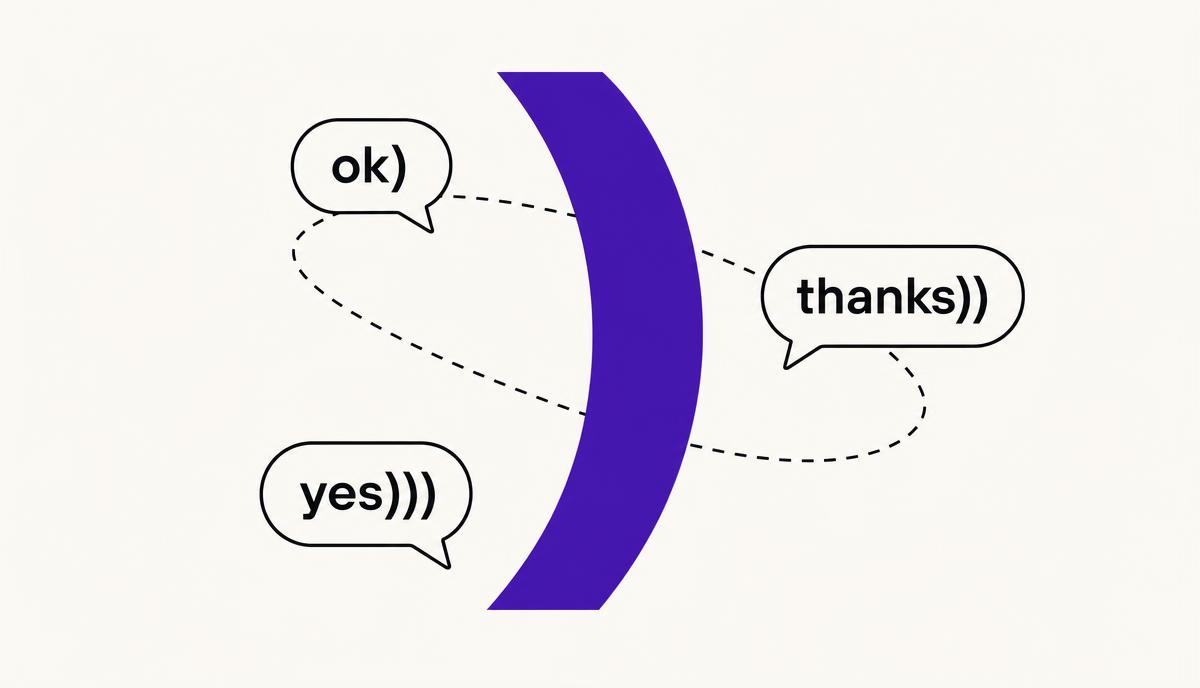
What Does ")" Mean in Chat? The Bracket Smiley, Explained
A lone ")" at the end of a message is a smiley with the eyes left off — and a strong signal you are talking to someone from Eastern Europe. Here is what it means, why it exists, and how to read it correctly.
How to Set Boundaries at Work (Without Sounding Difficult)
A practical guide to setting boundaries at work: the four kinds of limits worth defining, the sentences that hold them, how to handle pushback, and what to do when the boundary keeps getting crossed.
How to Ask for a Raise by Email (Templates and Scripts)
A practical guide to writing the email that asks for a raise: when to send it, what evidence belongs in it, three templates you can adapt, and the wording that keeps the tone confident rather than apologetic.