
How to Say No at Work Without Guilt

A practical script for declining requests clearly, kindly and without damaging the relationship
Saying no is the clearest test of assertive communication. Most people fail it in one of two directions: they agree to everything and quietly drown, or they refuse so bluntly that the relationship takes the damage instead of the calendar. Neither is necessary. A good no is short, specific and warm, and it fits in about three sentences.
Why saying no feels harder than it is
The discomfort rarely comes from the words. It comes from a prediction: that declining will be read as unhelpful, uncommitted or difficult. That prediction is usually wrong, and it is almost never tested. Most people have far more evidence about how their yes lands than about how their no lands, because they so rarely try one.
There is also a quieter cost that nobody sees. Every unnecessary yes borrows time from work you already committed to. The colleague you said yes to gets a fast answer; the colleague waiting on your existing deliverable absorbs the delay. Framed that way, saying no is not withholding help — it is deciding, out loud, who your help is going to.
Separate the request from the person
Declining a task is not rejecting a colleague. Keeping that distinction in your head is what switches off the apology reflex — the "I'm so sorry, I feel terrible, I really wish I could" spiral that precedes so many refusals. Over-apologising has a practical downside too: it signals that the no is negotiable, which invites a second ask, usually with more pressure attached.
The same principle governs difficult conversations in general — address the request, the behaviour or the deadline rather than the character of the person in front of you. The structure in navigating difficult conversations applies directly whenever a refusal is likely to be contested.
The three-part structure: acknowledge, decline, offer
Acknowledge the request so the other person knows they were heard. Decline in one plain sentence, in the present tense, without inventing an elaborate excuse. Then offer whatever you genuinely can — a later date, a smaller slice of the work, or the name of someone better placed to help.
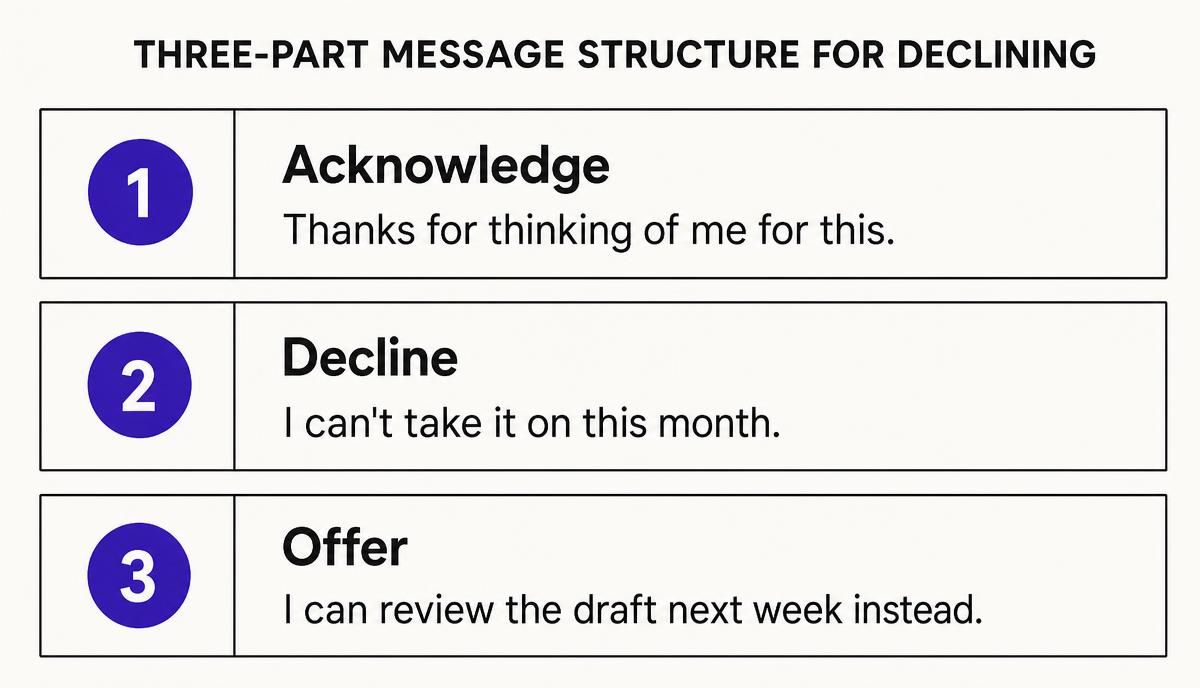
"Thanks for thinking of me for the launch deck. I can't take it on this week — I'm finishing the quarterly report. If it can wait until Monday, I can draft the first half then."
Three sentences, no guilt, no ambiguity. The offer is the part people skip, and it is the part that keeps the relationship warm. It also makes the no credible: someone who proposes an alternative is visibly weighing the request rather than deflecting it.
Give a reason, not a defence
One short clause is enough. Long justifications sound like you are asking permission, and they hand the other person a list of objections to argue with — if you cite three reasons, you have given them three things to solve. If the reason is capacity, say capacity. You do not owe anyone a calendar audit, and offering one invites negotiation over how you spend your week.
Avoid inventing a reason you would be embarrassed to have checked. Fabricated conflicts collapse the moment someone reschedules around them, and the recovery costs more trust than a plain refusal ever would.
Avoid the soft no that is not one
Certain phrases feel like refusals to the speaker and read as agreement to the listener. They are the main reason undelivered work surfaces at the worst possible moment.
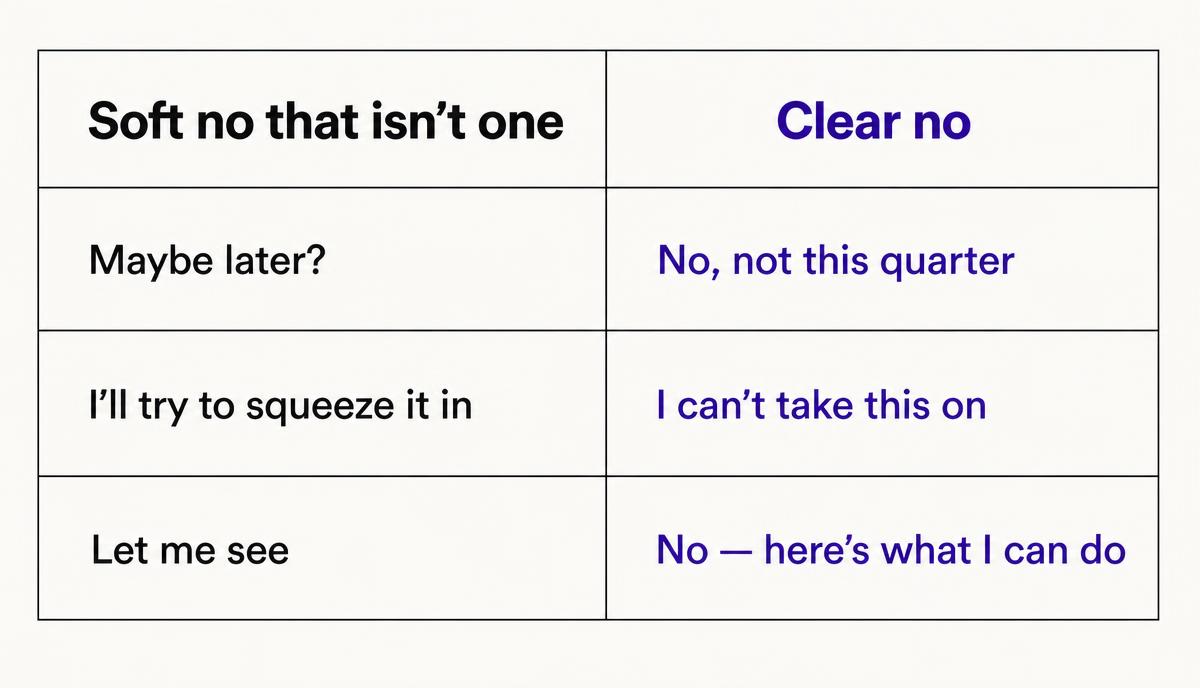
| What you say | What they hear | What to say instead |
|---|---|---|
| "I'll try." | It is handled. | "I can't this week. I could start Monday." |
| "Maybe — let me see." | Probably yes, waiting on confirmation. | "Let me check one thing and confirm by 3pm." |
| "I'm pretty busy right now." | Busy, but will squeeze it in. | "My week is committed to the audit. I can't add this." |
| Silence / no reply | No objection, so yes. | "Got this — the answer is no, here is why." |
| "Whatever works for you." | You choose; I will comply. | "Thursday works. Tuesday does not." |
A clear no on Tuesday is far kinder than a missed deadline on Friday. The soft no does not spare the other person discomfort; it postpones it and adds a surprise.
Saying no in writing
Written refusals are harder because there is no voice to carry the warmth. Blunt imperatives and one-word replies read as aggressive; strings of qualifiers read as passive. The assertive middle keeps the verbs direct and the framing collaborative — "I can't" rather than "I guess I probably shouldn't", "Could we move it to next sprint?" rather than "Whatever works for you." The full anatomy of those registers is in the guide to passive, assertive and aggressive communication.
A few habits make a written no land as intended:
- Answer in the same thread, promptly — a slow no reads as reluctance.
- Put the decision in the first line; do not make the reader hunt for it.
- Use one warm sentence, not three. Warmth stacked up becomes apology.
- Do not explain in a second message what you should have said in the first.
- Reread for sarcasm. Anything that sounds pointed out loud will sound worse in text.
Because email is the channel of record, a refusal there is also the version that gets forwarded. The conventions in the professional email etiquette guide are worth applying to any no that will outlive the conversation.
Saying no upward
Declining a manager's request is rarely a refusal in the pure sense; it is a prioritisation conversation. Do not say no to the task — say no to the collision. "I can take the client review, but then the audit slips to the 14th. Which do you want first?" hands the trade-off back to the person who owns the priorities, which is where it belongs.
This works because it removes the implication that you are unwilling. It also surfaces information your manager may not have: they usually cannot see how full your week already is, and they are rarely asking you to work a fourteen-hour day to absorb both.
When the no is repeated
If the request comes back, repeat your answer in the same words rather than escalating your tone. Calm repetition is more persuasive than a stronger version of the same refusal, and it avoids the trap of arguing about your reasons instead of restating your decision. Expect some discomfort the first few times and hold the line anyway; the discomfort fades much faster than the resentment of a yes you did not mean.
Listening still matters here. A repeated request often carries information — a deadline you did not know about, or a constraint that changes the calculation. Hearing it out before restating your position, as described in the piece on active listening, keeps the exchange from hardening into a standoff.
If you want to check how a refusal will land before you send it, paste the draft into SpeakWise. It flags passive, aggressive and passive-aggressive phrasing and shows the assertive rewrite, so your no stays firm, clear and respectful. The feature list explains what it checks.
Frequently asked questions
How do I say no without giving a reason?
Use a capacity statement and an offer: "I can't take this on right now, but I could look at it next week." You are not obliged to disclose what else is on your plate. What you should avoid is refusing with no reason and no alternative, which reads as disengagement rather than a boundary.
What if saying no damages my reputation?
Reputations are built on delivery, not on availability. The person who accepts everything and misses a third of it is remembered for the misses. A prompt, specific no with a realistic alternative reads as someone who manages their commitments — which is exactly the reputation worth having.
How do I decline something I already agreed to?
Say it as early as you know, own the change plainly, and bring a replacement plan. "I said yes to this on Monday and I got that wrong — the audit takes my whole week. I can hand it to Priya today, or deliver it on the 12th." Early and specific costs very little. Late and vague costs a great deal.
Is it ever better to just say yes?
Yes, when the request is genuinely small, when it is a rare ask from someone you have capacity to support, or when the work is squarely part of your role. The test is not whether you want to do it, but whether saying yes puts an existing commitment at risk. If it does not, agree and move on.
Related Articles

How to Set Boundaries at Work (Without Sounding Difficult)
A practical guide to setting boundaries at work: the four kinds of limits worth defining, the sentences that hold them, how to handle pushback, and what to do when the boundary keeps getting crossed.

How to Ask for a Raise by Email (Templates and Scripts)
A practical guide to writing the email that asks for a raise: when to send it, what evidence belongs in it, three templates you can adapt, and the wording that keeps the tone confident rather than apologetic.

Professional Email Etiquette: A Practical Guide
How to write professional emails that stay warm, clear and respectful — from subject line to sign-off