Passive vs. Assertive vs. Aggressive
The difference between passive, assertive and aggressive communication, how each one sounds in real messages, and how to move to the assertive middle.
Passive communication protects the relationship at the cost of your needs. Aggressive communication does the opposite. Assertive communication states your need plainly while treating the other person as an equal, which is why it is the only one of the three that tends to work twice with the same person.
The three styles in one paragraph each
Passive communication avoids friction. It hedges, apologises before it asks, buries the request, and often does not make the request at all. The passive speaker leaves the conversation with their point unmade and a private sense of being overlooked, which is accurate, because nobody heard it.
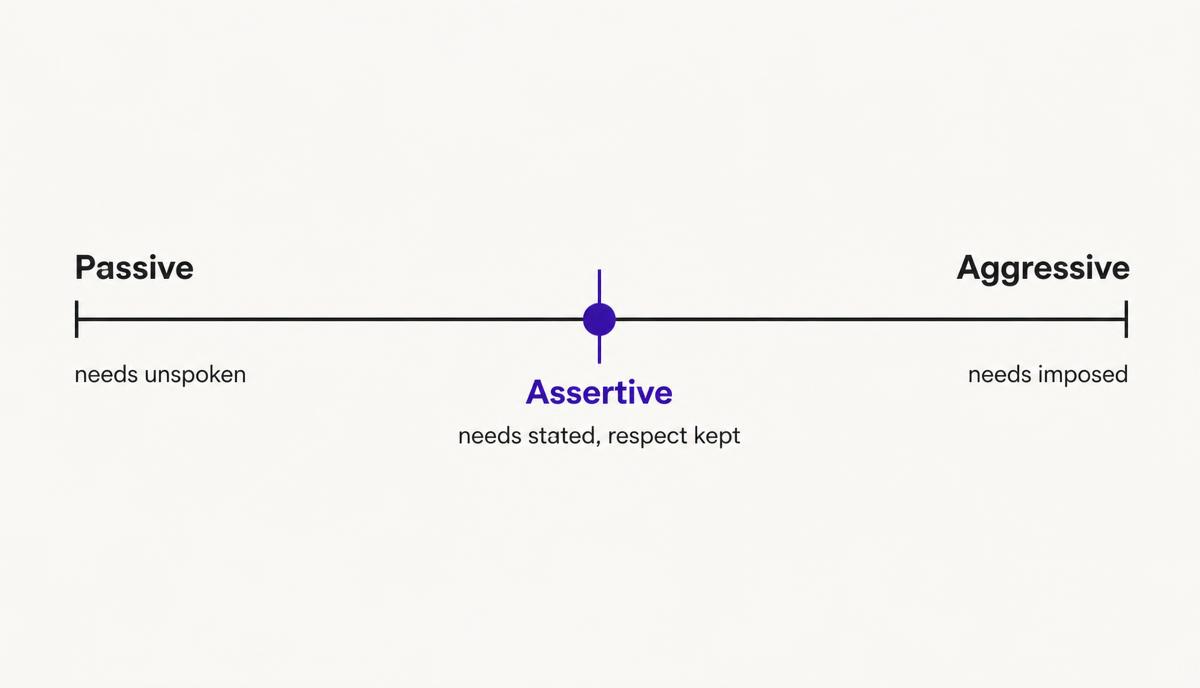
Aggressive communication treats the exchange as a contest. It states needs as demands, attributes motives, uses absolutes such as "always" and "never", and makes the other person responsible for the speaker's frustration. It often works in the short term, which is the trap: compliance is not agreement, and it decays.
Assertive communication states the need, the reason and the boundary in plain language, then leaves space for a response. It is not a midpoint between the other two on a politeness scale. It is a different stance entirely: both people's interests are treated as legitimate, and the conversation is a negotiation rather than a surrender or a win.
The fourth style nobody claims
Passive-aggressive communication is the one people rarely recognise in themselves. It expresses the aggression indirectly: the pointed "no worries!", the deadline reminder addressed to the whole channel, the compliment with a hook in it. It carries all the relational cost of aggression with none of the clarity, because the other person cannot respond to something that was never openly said.
How each style sounds in practice
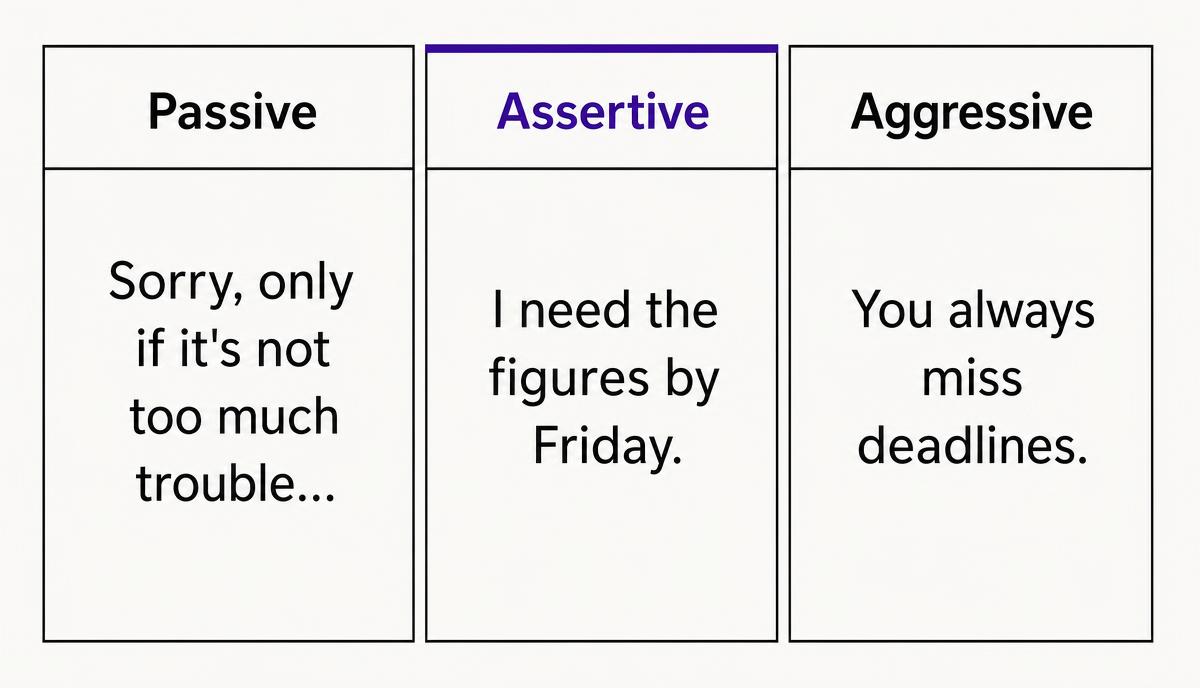
Style is easiest to identify in a concrete situation. Take one scenario: a colleague has missed a handover twice, and it is affecting your work.
| Style | What it sounds like | What it costs |
|---|---|---|
| Passive | "No problem at all, I picked it up again. Only if you have time next week!" | The pattern repeats, resentment builds, and the colleague never learns there was a problem. |
| Passive-aggressive | "Second time this week, but I guess I'll just do it myself 🙂" | The message is received as hostility, but nothing is stated clearly enough to resolve. |
| Aggressive | "You keep dropping this. I can't rely on you for anything." | Defensiveness, a damaged working relationship, and a fight about tone instead of handovers. |
| Assertive | "The handover has slipped twice and it pushed my Thursday back. Can we agree a fixed time for it?" | A short, uncomfortable moment, followed by a workable arrangement. |
The assertive version is barely longer than the aggressive one. What separates them is that it describes behaviour and impact instead of character, and it ends with a proposal rather than a verdict.
Why people end up passive or aggressive
Neither pattern is a character flaw. Both are learned strategies that once worked. Passive habits usually form where directness was punished: a household, a school or an early manager where raising a need reliably made things worse. Aggressive habits form where directness was the only thing that got heard, or where speed was rewarded over relationships.
Two other factors shape which register you reach for. Power is one: most people speak more passively upward and more bluntly downward, often without noticing the switch. Culture is another, since what counts as appropriately direct varies enormously, a point explored in the piece on how cultural differences shape communication.
Assertiveness is not about winning the exchange. It is about making sure the exchange actually contains what you needed to say.
How to move toward the assertive middle
Moving your default takes small, repeatable edits rather than a personality change. Start by noticing which direction you lean, then apply the correction that matches it.
If you lean passive
- Delete the pre-apology. "Sorry to bother you" trains people to treat your requests as optional.
- Cut hedges: just, maybe, a bit, kind of, if possible, whenever you get a chance.
- Use "I need" or "I'd like" instead of "It might be good if someone could".
- Give a real deadline instead of "no rush". A false no-rush is a passive-aggressive trap you set for yourself.
- Stop after the request. Silence is not a hole you have to fill with softening.
If you lean aggressive
- Remove absolutes. "Always" and "never" turn a solvable incident into a character trial.
- Describe the behaviour and its effect, not the person's motive. You cannot know the motive.
- Convert commands into requests with a question mark. The content survives; the fight does not.
- Add one line acknowledging the other side's constraints before you state yours.
- Wait before sending anything written while you are still annoyed. Twenty minutes is usually enough.
The three-part structure that works either way
Observation, impact, request. Describe what happened in checkable terms, say what it cost, then ask for something specific. "The spec changed after sign-off, which cost the team a week. Can we lock the scope at sign-off from now on?" It fits in three sentences, works in speech and in writing, and is difficult to read as either apologetic or hostile.
Assertiveness in writing, where it is hardest
Written messages remove the tone of voice that normally keeps a direct sentence warm, so assertive wording that sounds fine out loud can land as clipped on screen. The compensation is structure rather than softening: a greeting, a clear request, a reason, and an explicit invitation to reply. This is also the mechanism behind most professional email etiquette advice, which is really assertiveness dressed as formatting.
The hardest assertive message is a refusal, because the passive pull is strongest there. A firm, warm no follows the same three beats every time, and the walkthrough in how to say no at work without guilt gives you a script you can reuse.
Checking your own register is difficult from the inside, because a draft always sounds in your head the way you meant it. SpeakWise reads the draft the way a recipient will: it labels passive, aggressive and passive-aggressive phrasing, then shows an assertive rewrite you can compare against your original. The features page covers what it looks at.
Frequently asked questions
What is the difference between assertive and aggressive communication?
Assertive communication states your need while treating the other person as an equal with legitimate needs of their own. Aggressive communication states your need at their expense, usually by assigning blame or motive. The words can be equally direct; the difference is whether the other person is left room to respond.
How do I know if I am being passive-aggressive?
Check whether the literal words and your actual feeling match. If you write "no worries at all" while genuinely annoyed, or add a smiley to a pointed reminder, that gap is passive-aggression. The fix is to state the real thing plainly, or to let it go entirely.
Can you be assertive with your boss without seeming difficult?
Yes, and it is mostly about framing. Anchor the request in shared goals, bring a proposal rather than only a problem, and be specific about trade-offs: "I can take the audit if the report moves to next week — which would you prefer?" That reads as ownership, not resistance.
Is assertive communication rude in some cultures?
Directness levels vary, so the same sentence can read as clear in one setting and abrupt in another. Assertiveness travels well when you keep the clarity but adjust the packaging: more context and more relational framing where indirectness is the norm, less where it is not.
Related Articles
How to Set Boundaries at Work (Without Sounding Difficult)
A practical guide to setting boundaries at work: the four kinds of limits worth defining, the sentences that hold them, how to handle pushback, and what to do when the boundary keeps getting crossed.
What Does ")" Mean in Chat? The Bracket Smiley, Explained
A lone ")" at the end of a message is a smiley with the eyes left off — and a strong signal you are talking to someone from Eastern Europe. Here is what it means, why it exists, and how to read it correctly.
How to Ask for a Raise by Email (Templates and Scripts)
A practical guide to writing the email that asks for a raise: when to send it, what evidence belongs in it, three templates you can adapt, and the wording that keeps the tone confident rather than apologetic.