The Impact of Cultural Differences on Communication

How directness, context, hierarchy and time expectations shape cross-cultural communication at work — and how to adapt without stereotyping the person in front of you.
Cross-cultural misunderstanding at work is rarely about language. It is about unspoken defaults: how directly a "no" is expressed, how much meaning sits in the context rather than the words, how openly a junior person may disagree, and what a deadline is understood to mean. Two people can use the same English sentence correctly and walk away with opposite conclusions.
Culture as default settings, not rules
It helps to think of cultural norms as defaults rather than laws. They describe what a group tends to treat as normal, polite or professional when nobody has negotiated otherwise. Any individual may sit far from their group's default, and most people at work belong to several overlapping cultures at once: national, professional, organisational and generational.
That distinction matters because the alternative — treating cultural frameworks as predictions about individuals — is just stereotyping with better vocabulary. The useful application is not "this person will be indirect", but "the friction I am feeling may be a defaults mismatch rather than a personality problem, so I should check before I conclude."
Organisational culture often overrides national culture, too. An engineer in a flat, fast-moving startup and an engineer in a hierarchical multinational may share a passport and share almost none of their communication expectations.
The dimensions that cause the most friction
Directness and how disagreement is expressed
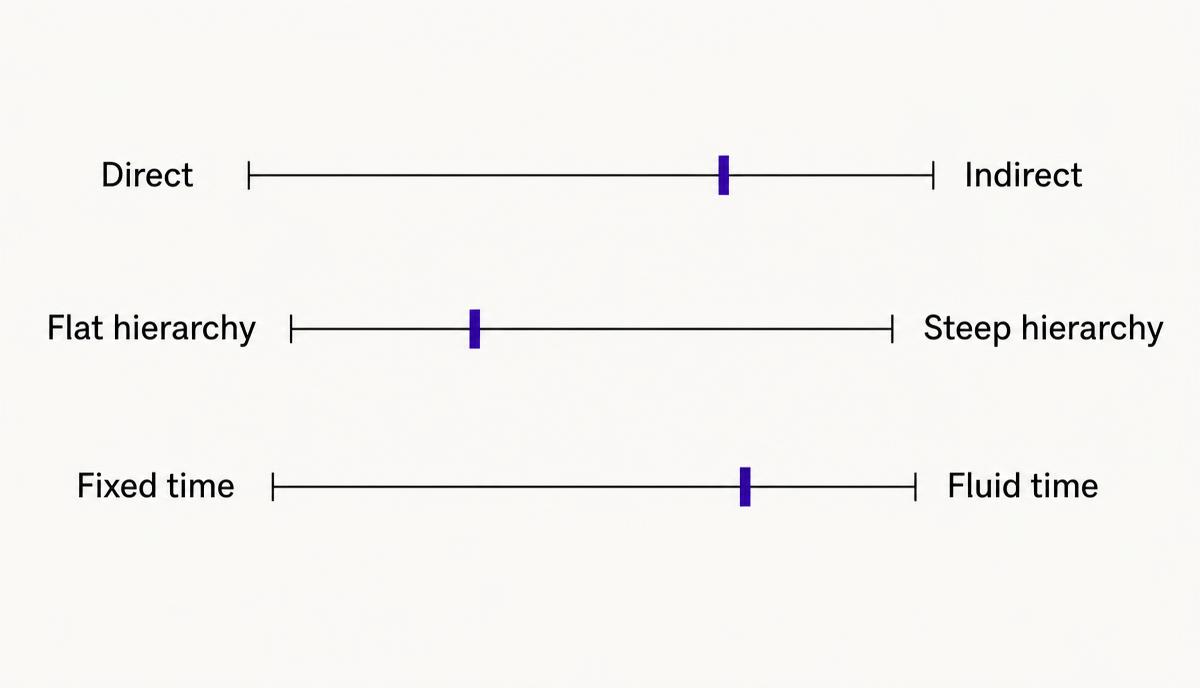
In some working cultures, saying "I disagree, and here is why" to a senior colleague is a sign of engagement. In others it is a breach of respect that damages the relationship and, incidentally, does not change the decision. Where directness is low, disagreement travels through hedges, questions, silence, or a private word afterwards.
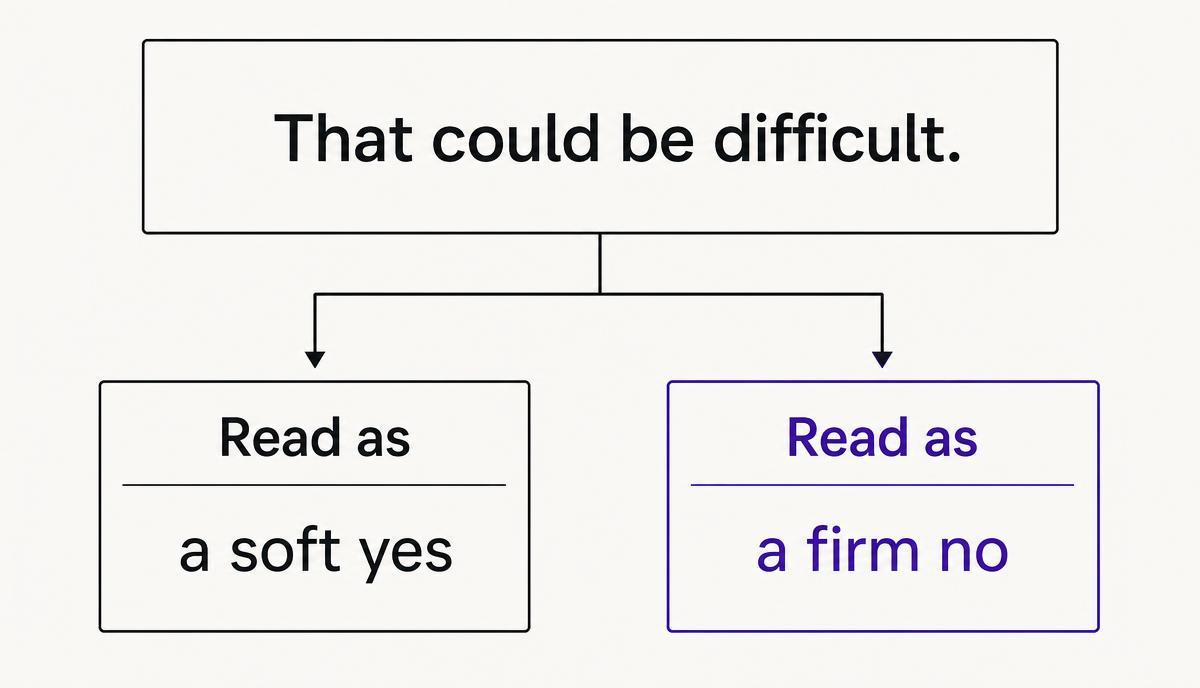
The mistake in both directions is symmetrical. Direct communicators hear "that may be difficult" as a manageable obstacle when it means no. Indirect communicators hear "this section does not work" as a personal attack when it means the section needs another draft.
High and low context
In high-context settings, much of the meaning lives outside the sentence: in the relationship, the shared history, who was copied on the message, what was left unsaid. In low-context settings, the words are expected to carry the whole load, and anything important should be stated explicitly. A high-context reader may spend an afternoon interpreting an email that was written with no subtext at all; a low-context reader may miss the point of a message entirely because it was never spelled out.
Hierarchy and who speaks
Expectations about hierarchy govern who may interrupt, who speaks first, whether you can skip a level to email a director, and whether silence in a meeting means agreement or deference. If you run meetings across such a gap, the absence of objections tells you nothing, and an open invitation to "jump in any time" will not be taken up.
Time, deadlines and pace
Some settings treat a deadline as a commitment and a schedule as a structure; others treat both as a plan that yields to relationships and circumstances. Neither is unprofessional in its own frame. The friction comes when nobody says which frame they are in, so one side is quietly recalculating dependencies while the other assumes there is give.
The same signal, two readings
The table below covers the misreadings that come up most often on distributed teams. In each case both interpretations are locally reasonable, which is exactly why the mismatch goes unnoticed.
| Signal | Read one way | Read another way |
|---|---|---|
| Silence in a meeting | Agreement, or nothing to add | Respect for seniority; objections will come privately |
| "That could be challenging." | A solvable difficulty worth discussing | A clear no, politely delivered |
| A very short email with no greeting | Efficient and respectful of time | Cold, abrupt, possibly angry |
| Detailed personal small talk before business | Delay and padding | Necessary groundwork for a working relationship |
| Direct critique of a document in a group call | Normal quality control | Public loss of face for the author |
| Missing an internal deadline without warning | A reliability problem | A minor adjustment that relationships absorb |
Practical adjustments that work in both directions
You cannot learn every culture on a fifteen-person distributed team, and you do not need to. A small set of habits handles most of the variance because they reduce reliance on shared defaults altogether.
- Make the implicit explicit: say whether a deadline is hard or soft, whether feedback is requested or required, and whether a decision is open or already made.
- Ask for confirmation in the other person's words rather than a yes/no. "What will you do first?" reveals a misunderstanding that "Does that work?" hides.
- Give disagreement a private route as well as a public one, so a norm against open objection does not silence the objection entirely.
- Write in plain sentences, avoid idiom and sport metaphors, and drop humour that relies on shared references. Clarity travels; wit rarely does.
- Slow down decisions that arrived suspiciously smoothly. Frictionless agreement across a hierarchy gap often means the concerns are still unspoken.
- When something reads as rude, assume a defaults mismatch first and ask a clarifying question before responding to the tone.
Two of these deserve emphasis for remote teams. Because the visual cues that would normally soften a direct remark are largely absent on video — see body language in the digital age — written and spoken words carry more weight across cultures than they would in a room. And because ambiguity in text is filled in by the reader's own expectations, the negativity effects described in the psychology of digital messaging are amplified when the reader's defaults differ from yours.
Language fluency is not cultural fluency
A colleague with excellent English may still be operating on entirely different conversational defaults, and fluency can mask that. It also costs real effort: working in a second language consumes attention that would otherwise go to nuance. Sending an agenda in advance, writing decisions down, and leaving longer pauses for responses cost you very little and remove a significant handicap.
Adapting without losing yourself
Adapting does not mean abandoning clarity or agreeing to things you do not want. The stable approach is to keep the substance of your message constant and vary the packaging: more context and relational framing where indirectness is expected, more explicit structure where it is not. The assertive core described in passive vs. assertive vs. aggressive survives translation; the bluntness around it is what should flex.
Where a genuine clash persists, name it as a process question rather than a personal one: "We seem to have different assumptions about how firm this date is — can we agree what we mean by it?" That is a conversation about defaults, and it is much easier to have than a conversation about who was unreasonable.
Frequently asked questions
How do I avoid stereotyping while still preparing?
Use cultural frameworks to generate questions, not conclusions. Knowing that a colleague's working culture tends toward indirectness should prompt you to check how they prefer to give feedback — not to assume they will never disagree openly.
Someone's emails feel rude. Is that cultural?
Often, yes. Greeting conventions, apology frequency and directness vary widely, and a message written in a terse local style reads as hostile elsewhere. Respond to the content, and if it keeps bothering you, ask a neutral question about the substance rather than raising the tone.
How should I run a meeting with a mixed group?
Send the agenda ahead, invite people by name rather than asking the room, allow written input during and after the call, and confirm decisions in writing. Those four habits let both high-context and low-context participants contribute without either having to change how they work.
Does English as a shared language solve this?
It solves vocabulary, not expectations. The trickiest failures happen between fluent speakers, because everyone assumes comprehension is complete. Writing plainly, as described in writing for clarity, does more for cross-cultural understanding than a larger shared vocabulary.
Related Articles
How to Set Boundaries at Work (Without Sounding Difficult)
A practical guide to setting boundaries at work: the four kinds of limits worth defining, the sentences that hold them, how to handle pushback, and what to do when the boundary keeps getting crossed.
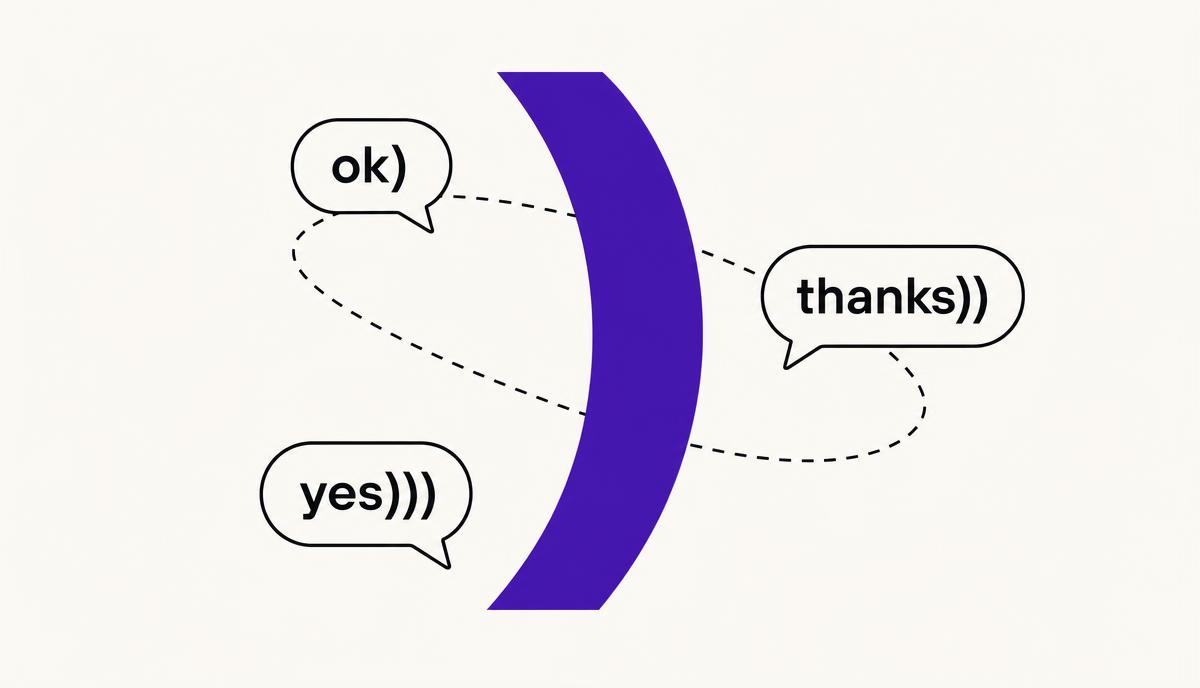
What Does ")" Mean in Chat? The Bracket Smiley, Explained
A lone ")" at the end of a message is a smiley with the eyes left off — and a strong signal you are talking to someone from Eastern Europe. Here is what it means, why it exists, and how to read it correctly.
How to Ask for a Raise by Email (Templates and Scripts)
A practical guide to writing the email that asks for a raise: when to send it, what evidence belongs in it, three templates you can adapt, and the wording that keeps the tone confident rather than apologetic.