Writing for Clarity: Simplifying Complex Ideas

How to explain complicated things simply without dumbing them down: structure, sentence craft, concrete language, and the revision passes that do the real work.
Clear writing is not simple writing. It is writing where the reader spends all of their effort on the idea and none of it on the sentence. That comes from three things: deciding what the reader actually needs, putting the conclusion before the reasoning, and cutting every word that is doing no work. Vocabulary is the last and smallest part.
Clarity is a property of the reader, not the text
A paragraph is not clear in the abstract. It is clear to a particular person with a particular amount of background. The same explanation of a database migration can be perfectly transparent to an engineer and completely opaque to the finance director who has to approve the cost. Both readers are reasonable; the writer chose one and not the other, usually without noticing.
So the first decision is not how to phrase anything. It is who this is for, what they already know, and what they need to do with it. Once those are settled, most of the wording questions answer themselves: you keep the terms your reader already owns and explain the ones they do not.
The curse of knowledge
The main obstacle is that you cannot un-know the thing you are explaining. Once a concept is familiar, the steps you took to learn it disappear, and the explanation you write skips them. This is why experts write the worst explanations of their own subjects, and why the fix is structural rather than stylistic: name your assumed knowledge explicitly before you draft, and check whether your reader has it.
Structure before sentences
Most writing that feels confusing is not badly worded — it is badly ordered. The reader is asked to hold five facts in mind before being told what they add up to, and by the time the point arrives they have dropped two of them.
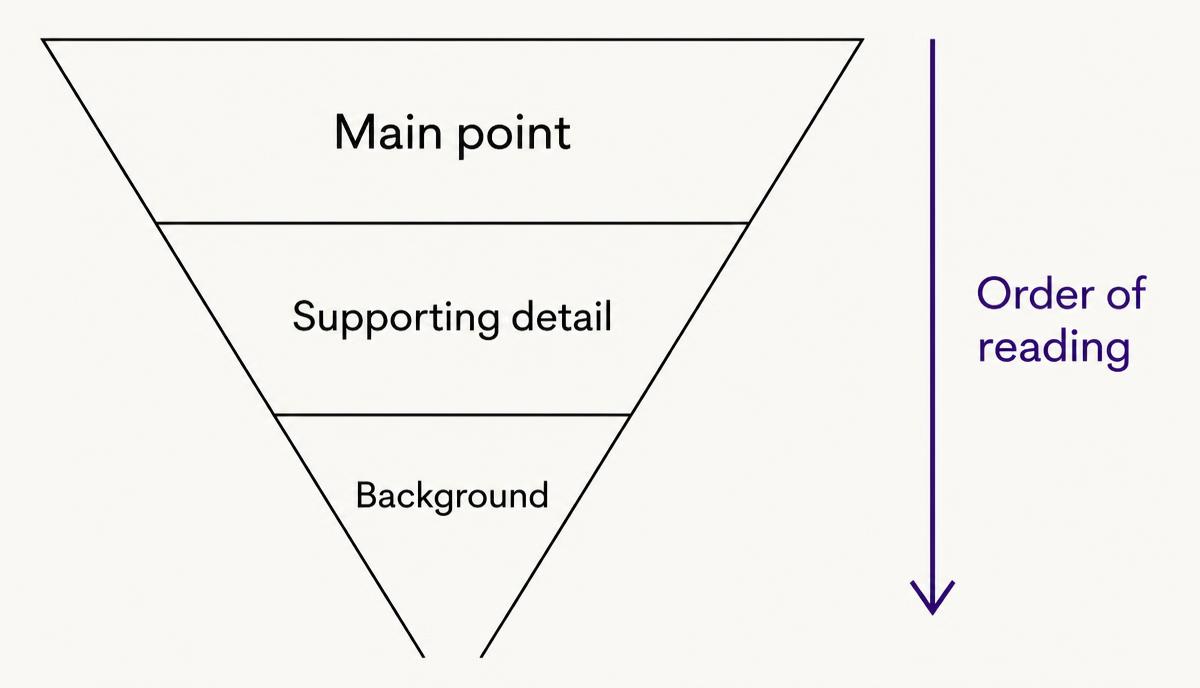
Put the conclusion first, then the reasoning. "We should delay the launch by two weeks. The payment integration fails on one gateway, and the fix requires a vendor change we cannot schedule sooner." A reader who agrees can stop after the first sentence, and a reader who does not knows exactly what the rest of the text is defending. This is the same principle that makes a good email subject line work, applied to the paragraph.
Then give each paragraph one job. If you cannot summarise a paragraph in a short phrase, it is holding two ideas and should be two paragraphs. Add headings once the document passes a screen or so, and write them as statements rather than labels — "Why the integration fails" tells the reader more than "Background".
Use the shape of the page
Lists, tables and short paragraphs are not decoration; they are instructions about how the information relates. A list says these items are parallel. A table says compare across these dimensions. A wall of prose says nothing, so the reader has to derive the structure themselves — which is work you could have done for them.
Sentence-level habits that carry most of the weight
A handful of recurring patterns account for the majority of unclear sentences in professional writing.
| Pattern | Example | Repair |
|---|---|---|
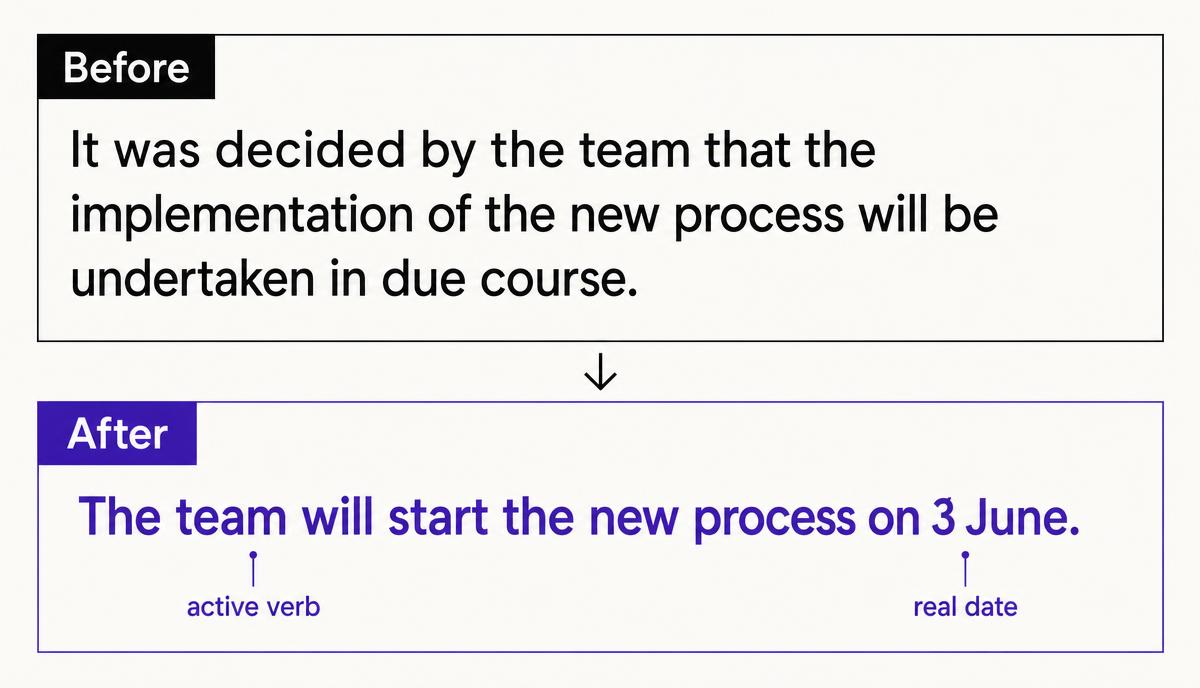
| Hidden actor | A decision was made to postpone the rollout. | The steering group postponed the rollout. |
| Nominalisation | We will conduct an evaluation of the process. | We will evaluate the process. |
| Stacked qualifiers | It may potentially be somewhat delayed in certain cases. | It will probably be a week late. |
| Abstraction with no example | We need better cross-functional alignment. | Design and support should agree the release notes before launch. |
| Unexplained jargon | The idempotency key prevents duplicate charges. | A one-time ID stops the same payment being taken twice. |
| Overlong sentence | A 45-word sentence with three clauses and two asides. | Three sentences, one idea each. |
The single highest-yield habit in that list is naming the actor. Passive constructions and abstract nouns hide who does what, and in workplace documents that ambiguity is often the actual problem: "the data will be reviewed" leaves every reader assuming someone else is reviewing it.
Prefer the concrete
Concrete language is easier to picture and therefore easier to remember. Replace category words with instances, and quantities with numbers where you have them. "Several stakeholders raised concerns" becomes "Two clients asked whether their data moves region." The second version is shorter, more useful, and much harder to misinterpret.
Analogies, used carefully
A good analogy maps something unfamiliar onto something the reader already understands, which is why it can compress a page into a sentence. It also imports every property of the familiar thing, including the wrong ones. Use analogies to get someone through the door, then say where the comparison stops holding.
Revision is where clarity is made
First drafts are for you: they are how you find out what you think. Revision is for the reader. Doing both at once is what makes writing slow and the result muddy, because you are trying to discover an argument and present it in the same pass.
- Pass one, structure: does the conclusion appear early, and does each section have one job? Reorder before you polish.
- Pass two, compression: cut ten per cent. Adverbs, throat-clearing openers and phrases like "in order to" go first, and nothing is lost.
- Pass three, actors and verbs: for each sentence, who is doing what? Replace hidden actors and abstract nouns with people and verbs.
- Pass four, jargon: mark every term your reader might not own. Define, replace, or delete each one.
- Pass five, read it aloud: anything you stumble over is a sentence the reader will stumble over silently.
Readability scores can be a rough smoke alarm for long sentences, but they measure syllables and length, not comprehension. A text can score well and still be meaningless. The only real test is whether a representative reader can tell you back what it said — the same confirmation loop that makes active listening work, applied to a document.
Simplifying is not softening
Clear writing sometimes feels blunt, especially when the news is bad, and the temptation is to reintroduce hedges to cushion it. Do not solve tone with vagueness. Keep the sentence precise and handle the human part explicitly, in the way described in passive vs. assertive vs. aggressive. "The pilot did not hit its target, and here is what we are changing" is kinder than a paragraph the reader has to decode.
Frequently asked questions
Does writing simply make me look less expert?
The opposite, usually. Dense prose signals that a writer has not finished thinking; the ability to explain something precisely in plain terms is difficult to fake. Keep the technical terms your audience genuinely needs and drop the ones that are only there for texture.
How do I write for a mixed audience?
Layer the document. Lead with a short summary that any reader can follow, then put the technical detail in clearly labelled sections underneath. Nobody has to read the parts that are not for them, and nobody has to guess where their part begins.
How short should sentences be?
There is no target. Vary them — a run of very short sentences reads as choppy and hides the relationships between ideas. The practical rule is one main idea per sentence, and if you need to reread your own sentence to parse it, split it.
Can I use AI to simplify my writing?
It is good at compression, flagging jargon and offering alternative phrasings, and poor at knowing what your specific reader already understands. Use it as a revision partner on wording, and keep the decisions about audience, structure and what to leave out for yourself.
Related Articles
How to Set Boundaries at Work (Without Sounding Difficult)
A practical guide to setting boundaries at work: the four kinds of limits worth defining, the sentences that hold them, how to handle pushback, and what to do when the boundary keeps getting crossed.
What Does ")" Mean in Chat? The Bracket Smiley, Explained
A lone ")" at the end of a message is a smiley with the eyes left off — and a strong signal you are talking to someone from Eastern Europe. Here is what it means, why it exists, and how to read it correctly.
How to Ask for a Raise by Email (Templates and Scripts)
A practical guide to writing the email that asks for a raise: when to send it, what evidence belongs in it, three templates you can adapt, and the wording that keeps the tone confident rather than apologetic.