Crafting Compelling Email Subject Lines

How to write subject lines that get opened and answered: naming the topic, adding the action, sizing for mobile, and the patterns that quietly kill replies.
A subject line has one job: tell the reader what this message is about and what it wants from them, in the width of a phone screen. Almost every weak subject line fails one of those two halves — it names a topic with no action, or it hints at an action with no topic. Fix both and your email stops sitting unread at the bottom of someone's afternoon.
What a subject line is actually for
People do not read their inbox. They triage it. A reader scans a column of short strings and makes a rapid three-way decision about each one: open now, defer, or ignore. Your subject line is not a headline competing for attention in a general sense — it is a piece of routing information competing with twenty other pieces of routing information, most of which were also written in a hurry.
That reframing changes what "compelling" means. A compelling subject line is not clever. It is legible. It gives the reader enough to place the message in their mental map of the week — this belongs to the budget thread, this needs me before Friday, this is background — without opening it. Curiosity gaps work occasionally in marketing and almost never at work, because a colleague who cannot tell what your message is about will simply defer it.
The same principle that governs the body of a professional message governs its subject: make the other person's job easier. The habits in professional email etiquette start here, before the greeting.
The two-part formula: topic plus action
The most reliable structure for a working subject line is a topic, a separator, and an action or deadline. "Q3 budget — need your headcount figures by Thursday." "Onboarding doc — review requested, 10 min." "Client call Friday — agenda inside, no action needed." Each one tells the reader what part of their world this touches and what happens next.
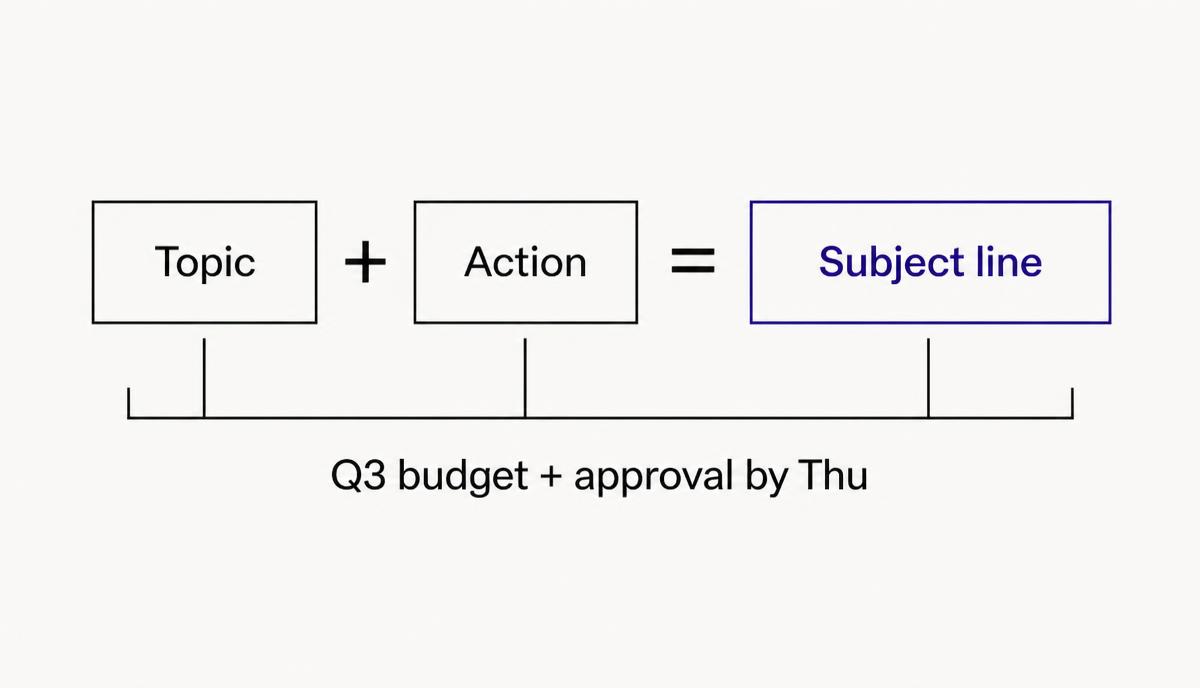
The separator matters more than it looks. An em dash or a colon splits the line into two scannable halves, so the reader's eye picks up the topic even when the rest is truncated. A single run-on clause forces them to read left to right to the end, which in a crowded inbox they will not do.
Front-load the words that identify the thread
Mobile clients typically show somewhere between thirty and fifty characters before cutting off. Whatever you put first is the only part guaranteed to be read. Put the project name, the client name, or the document name at the start. Save the polite framing — "Quick note about", "Following up on" — for the body, or drop it entirely. "Following up on the Q3 budget headcount figures" truncates to "Following up on the Q3 bu…", which is four wasted words at the exact point of maximum attention.
Name the action, not your feelings about it
"Urgent" is a claim about your priorities. "Needed by 2pm Thursday" is information the reader can act on. Deadlines, time estimates and explicit verbs — review, approve, decide, sign, no action — all do work that adjectives cannot. If a message genuinely is urgent, the deadline proves it; if it is not, the word "urgent" spends credibility you will want later.
Weak lines and their repaired versions
Most bad subject lines are not offensive, just empty. The table below takes the common ones and shows what changes when you apply the topic-plus-action rule.
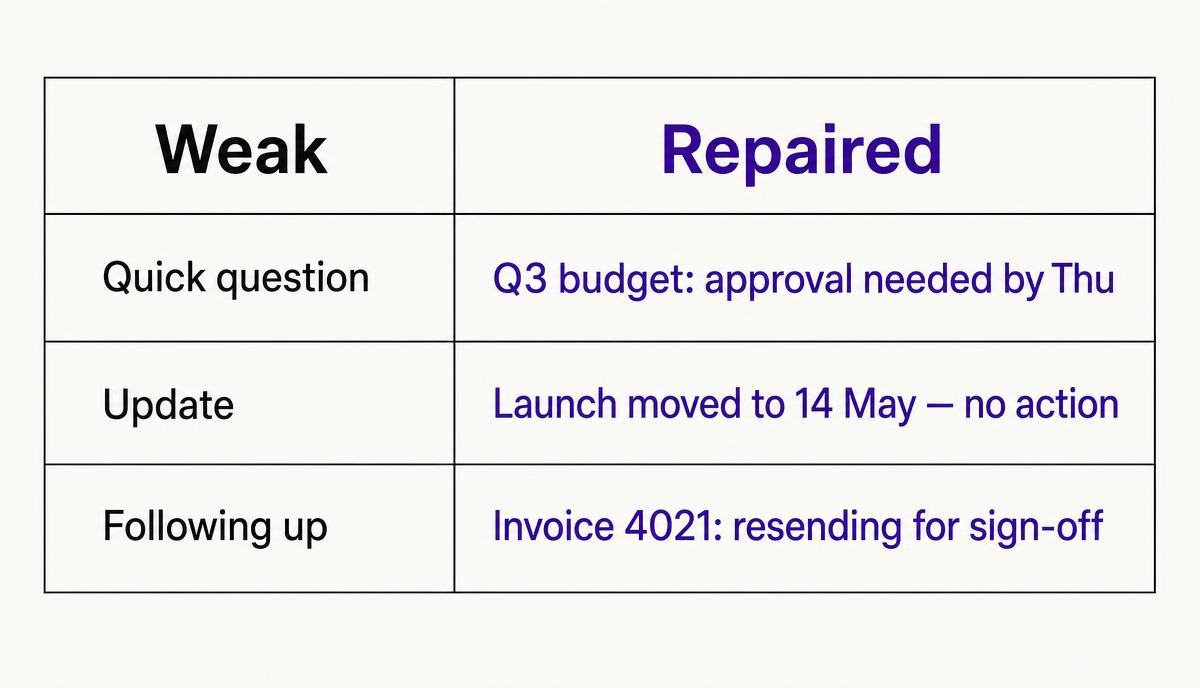
| Weak subject line | Why it stalls | Stronger version |
|---|---|---|
| Quick question | No topic, no action; the reader cannot rank it against anything else in the inbox. | Invoice template — which version is current? |
| Following up | Refers to a conversation the reader may not remember, and asks for nothing specific. | Vendor contract — decision needed by Fri 3pm |
| Meeting | Names a format, not a subject; likely to be deferred until the reader has time to open it. | Roadmap sync Thu 10am — agenda + prep doc |
| URGENT!!! Please read | Signals emotion rather than information, and erodes trust when the content is routine. | Payroll cutoff moved to Tue — action by Mon EOD |
| Re: Re: Re: Fwd: notes | Thread history has replaced the topic; nobody can tell what the current message concerns. | Launch notes — final copy for sign-off |
| Touching base | Relationship language with no content; reads as a sales cadence even from colleagues. | Onboarding status — two blockers to resolve |
Tone in twelve words
A subject line carries tone whether you intend it to or not, and it carries it with no context to soften it. "We need to talk" is a neutral sentence that has caused an unusual amount of human distress. Because the reader sees the subject before any explanation, it is the single highest-risk piece of text in the message.
Two habits reduce the damage. First, avoid bare escalation words — problem, issue, concern, mistake — without an object. "Concern about the deck" invites the reader to imagine the worst for as long as it takes them to open it; "Deck: slide 4 numbers don't match the report" tells them exactly how big the problem is. Second, do not put blame in the subject. "Your section is late" is a public label that survives in the inbox long after the matter is resolved.
This is the same negativity bias that distorts short chat messages, described in the psychology of digital messaging. A subject line is the shortest message you will send all day, which makes it the most exposed to that effect.
When the news is bad
For genuinely difficult content, the subject should be accurate and flat: "Timeline change — launch moves to 14 Oct". No softening, no drama. The reader learns the fact immediately and reads the body for the reasoning, which is far kinder than an ambiguous line that leaves them guessing. If the conversation warrants more care than a subject line allows, that is a signal to pick a different channel — see navigating difficult conversations.
Marketing subject lines follow the same logic
Newsletter and campaign subject lines have a different reader relationship — permission-based, easy to unsubscribe from, competing against commercial mail rather than colleagues — but the underlying mechanics hold. Specificity outperforms cleverness, the first thirty characters carry the message, and a promise the body does not keep costs you the next ten opens.
Three differences are worth noting. Personalisation tokens can help but fail loudly when the data is wrong, so guard them with sensible fallbacks. Question-form lines invite a mental answer, and if the honest answer is "no", the mail is gone. And curiosity, which is dead weight internally, does have a role in campaigns — provided the body pays it off in the first line rather than three scrolls down.
Test one variable at a time
If you run subject line tests, change one thing per test — length, or the presence of a deadline, or personalisation — and keep the send window constant. Testing two changes at once tells you that something worked without telling you what, which produces confident conclusions built on nothing.
A checklist before you hit send
- Can the reader tell the topic from the first thirty characters alone?
- Is there a verb, a deadline, or an explicit "no action needed"?
- Would the line still make sense if the reader saw it a week from now?
- Does it avoid blame, vague alarm and unqualified urgency?
- If the thread has drifted, have you rewritten the subject to match the current topic?
- Does the first line of the body deliver on what the subject promised?
Rewriting the subject when a thread changes topic is the most commonly skipped item and the most useful. A thread called "Re: Re: kickoff" that now contains the contract terms is effectively unsearchable, both for you and for whoever inherits the account later. Clear naming here is part of the broader habit of writing for clarity.
Frequently asked questions
How long should an email subject line be?
Aim for roughly six to ten words, with the identifying words first. Mobile clients truncate somewhere in the thirties or forties of characters, so treat everything after that as a bonus rather than something the reader will definitely see.
Should I use emoji in subject lines?
In consumer campaigns they can help a line stand out in a crowded promotions tab. In internal and client email they mostly read as informal, and some corporate mail clients render them inconsistently. If in doubt, leave them out and spend the space on a clearer noun.
Is it rude to write in all caps or add multiple exclamation marks?
Capitals read as shouting to most recipients, and stacked exclamation marks read as either panic or hype. Both push a message toward the aggressive end of the register described in passive vs. assertive vs. aggressive. A deadline communicates urgency without the cost.
What should I do when nobody replies?
Send a new message with a rewritten subject rather than replying "bump" on the old thread. The original line probably failed at triage, and repeating it inside the same thread gives the reader no new reason to open it. Name the topic, name the deadline, and keep the body to three sentences.
Related Articles

Professional Email Etiquette: A Practical Guide
How to write professional emails that stay warm, clear and respectful — from subject line to sign-off
How to Set Boundaries at Work (Without Sounding Difficult)
A practical guide to setting boundaries at work: the four kinds of limits worth defining, the sentences that hold them, how to handle pushback, and what to do when the boundary keeps getting crossed.
What Does ")" Mean in Chat? The Bracket Smiley, Explained
A lone ")" at the end of a message is a smiley with the eyes left off — and a strong signal you are talking to someone from Eastern Europe. Here is what it means, why it exists, and how to read it correctly.