Mastering Professional Communication
How to write and speak at work so people understand you the first time: structure, tone, channel choice and scripts for the hard conversations.
Professional communication is mastered by doing three things consistently: state what you need early, choose a tone that is direct without being harsh, and match the channel to the weight of the message. Everything else is refinement. If you fix only those three habits, most of the confusion, chasing and quiet friction in your working week disappears.
What professional communication actually means
Professional communication is not formality. It is not long sentences, Latin connectives, or the reflex to write "Please be advised that" when you mean "Heads up". It is the practice of transferring a thought from your head into someone else's with as little distortion as possible, in a way that respects their time and their standing.
That definition has a useful consequence. Every choice you make in a message can be judged against a single question: does this make the other person's job easier or harder? A vague subject line makes it harder. A buried request makes it harder. A three-paragraph apology in front of a simple question makes it harder, because the reader has to excavate the point before they can act on it.
The people you consider excellent communicators at work are rarely the most eloquent ones. They are the ones whose messages you never have to read twice.
Start with the outcome, not the opening line
Before you write anything, finish this sentence: after reading this, I want them to ____. Approve the budget. Send the figures by Friday. Know that the launch slipped and take no action. When you can name the outcome, the shape of the message writes itself, and you stop producing the kind of update that leaves everyone unsure whether they were asked for something.
Name the ask in the first two sentences
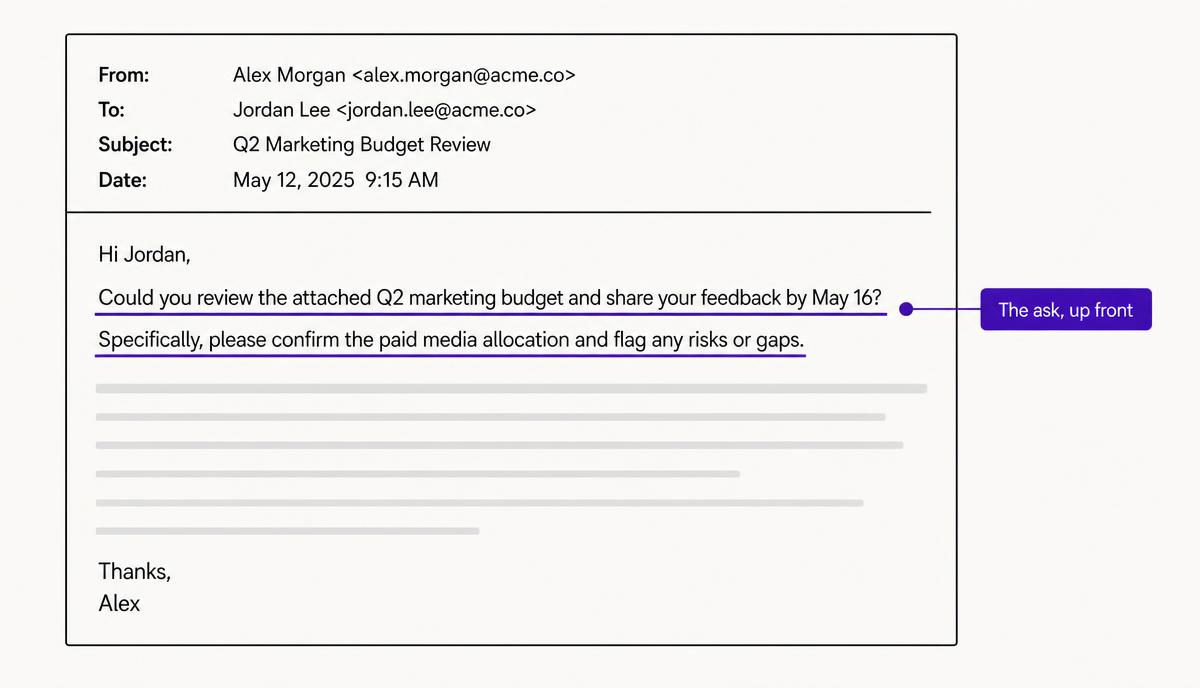
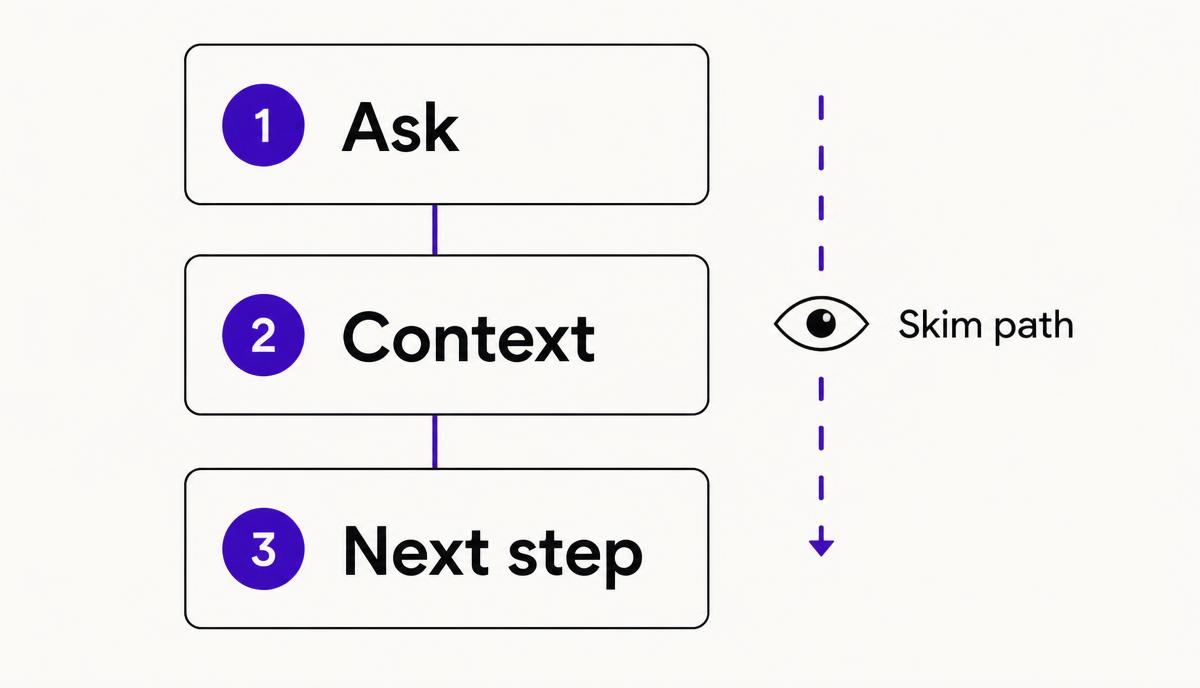
Professional readers skim. They open a message, scan for a verb aimed at them, and move on if they do not find one. Put the request at the top and the context underneath it, in the order a reader needs it rather than the order you happened to think of it. If there is more than one request, use a short list so nothing has to be chased later. The same principle governs the subject line, which is why writing subject lines that name the topic and the action does more for your response times than any amount of polish inside the message.
Match the channel to the message
Channel choice is a communication skill, not an administrative detail. Chat is for things that are cheap to get wrong and quick to correct. Email is for anything that needs a record, a deadline, or more than one reader. A call or a meeting is for anything with emotional weight, genuine disagreement, or a decision that will take three rounds of writing to reach. Sending bad news over chat is not efficient; it is a way of avoiding the discomfort of delivering it, and the recipient can usually tell.
One rule prevents most channel mistakes: if you are choosing a channel because it is easier for you rather than clearer for them, choose again.
Tone is a choice, not a personality trait
People often describe themselves as "just blunt" or "too soft" as if tone were fixed at birth. It is not. Tone is the sum of small, changeable choices: which verb you pick, whether you hedge, whether you attribute intent, whether you leave room for a reply. Written communication strips out voice and face, so those choices carry the entire emotional load of the message.
The table below shows the same underlying request written three ways. The content is identical. What changes is how much repair work the reader has to do before they can respond.
| What you write | How it reads | What usually happens next |
|---|---|---|
| "Sorry to bother you again, I know you're swamped, but if you get a chance maybe the report?" | Passive. The request sounds optional and slightly anxious. | It slides to the bottom of the pile; you ask a third time. |
| "I need the report. It was due yesterday." | Aggressive. Accurate, but framed as an accusation. | You get the report and a colder working relationship. |
| "Could you send the report by Friday? Let me know if that timing is difficult." | Assertive. Clear need, clear deadline, room to negotiate. | You get a date, or an honest reason you can plan around. |
| "No rush at all, whenever suits you!" (when there is a deadline) | Passive-aggressive by accident. The words and the reality disagree. | The deadline is missed and you feel unable to raise it. |
Notice that the assertive version is not the longest or the politest. It is the one that gives the reader everything they need to act: the thing, the date, and permission to push back. If you want the mechanics behind those three registers, the breakdown of passive, assertive and aggressive communication styles covers how each one is built and where each one comes from.
Writing that survives skimming
Assume your reader is on a phone, between meetings, with your message half-visible in a preview pane. Writing that survives those conditions follows a few habits that cost nothing:
- Put one idea in each paragraph, and keep paragraphs to three or four lines on a phone screen.
- Front-load the sentence. "The launch moved to the 12th because QA found two blockers" beats "Because QA found two blockers, the launch has moved."
- Use bold sparingly and only on the action or the date, never on whole sentences.
- Replace abstractions with the concrete thing. "Alignment issues" tells the reader nothing; "Design and engineering disagree on the onboarding flow" tells them everything.
- Cut every sentence that exists to soften the previous sentence. If the previous sentence needs softening, rewrite it instead.
- Reread once before sending, ideally out loud. It catches tone problems that silent reading hides.
Complexity is the other enemy of skimming. When you are explaining something technical to a non-technical reader, the goal is not to sound accessible but to actually be understood, which is a different discipline covered in the guide to explaining complex ideas in plain language.
Listening is half of professional communication
Most advice about workplace communication is really advice about transmitting. The harder half is receiving. In meetings, the person who repeats back what they heard before responding prevents more rework than anyone with a well-structured argument, because they catch the misunderstanding while it is still cheap.
If you cannot restate the other person's position in a way they would accept, you are not ready to disagree with it.
Practically, that means asking one clarifying question before you offer an opinion, resisting the urge to draft your reply while they are still talking, and treating silence as thinking time rather than an empty slot to fill. These are trainable habits, and the deeper mechanics are worth reading in the piece on how active listening changes conversations.
Handling disagreement without damage
Disagreement is where professional communication is actually tested. The move that works in almost every case is to separate the problem from the person and to describe behaviour rather than character. "The spec changed twice after sign-off and it cost us a week" is a fact you can both look at. "You keep moving the goalposts" is a verdict that invites defence.
Then state what you want, not just what you object to. Objections without a proposal leave the other person to guess at a fix, and they usually guess wrong. If the conversation is likely to be tense, plan the first sentence in advance and let the rest be improvised; the opening sets the register for everything that follows.
When the topic is genuinely difficult, such as feedback on performance or pushing back on a senior colleague, structure matters more than instinct. The framework in navigating difficult conversations gives you an order of operations to fall back on when the emotional temperature rises.
Build the habit, not the one-off message
Improvement here is not a matter of learning phrases. It comes from noticing your own default. Some people default to hedging and need to remove qualifiers; others default to compression and need to add a line of warmth. Look back at ten messages you sent last week and mark which way they lean. Whichever direction you find, the correction is small and repeatable.
A second pair of eyes speeds that up, which is the practical reason SpeakWise exists: you paste a draft, it flags passive, aggressive and passive-aggressive phrasing, and it shows you the assertive rewrite so you can see the pattern rather than guess at it. The full feature list explains what it checks.
Frequently asked questions
How do I sound more confident in emails without sounding rude?
Remove the qualifiers and keep the warmth. Cut "just", "sorry to bother", and "I was wondering if maybe", then add one human line such as "Let me know if that timing is difficult." Confidence comes from a clear request and a clear deadline, not from a harder tone.
What should I do when someone does not reply to my message?
Follow up once in the same thread, restate the ask in one line, and give a new date. Assume the message was missed rather than ignored. If the second attempt also goes unanswered, change channel: a two-minute call resolves what a fourth email will not.
Is it unprofessional to use emoji at work?
It depends on the channel and the relationship. In internal chat with people you know, a single emoji often prevents a short message from reading as cold. In formal email, first contacts, or anything involving money, contracts or performance, leave them out and carry the warmth in the wording instead.
How long should a professional email be?
Short enough to read on one phone screen without scrolling, which is roughly 100 to 150 words. If the topic genuinely needs more, put the request and the deadline at the top, then add the detail below under a heading or a list so the reader can choose how deep to go.
Related Articles
How to Set Boundaries at Work (Without Sounding Difficult)
A practical guide to setting boundaries at work: the four kinds of limits worth defining, the sentences that hold them, how to handle pushback, and what to do when the boundary keeps getting crossed.
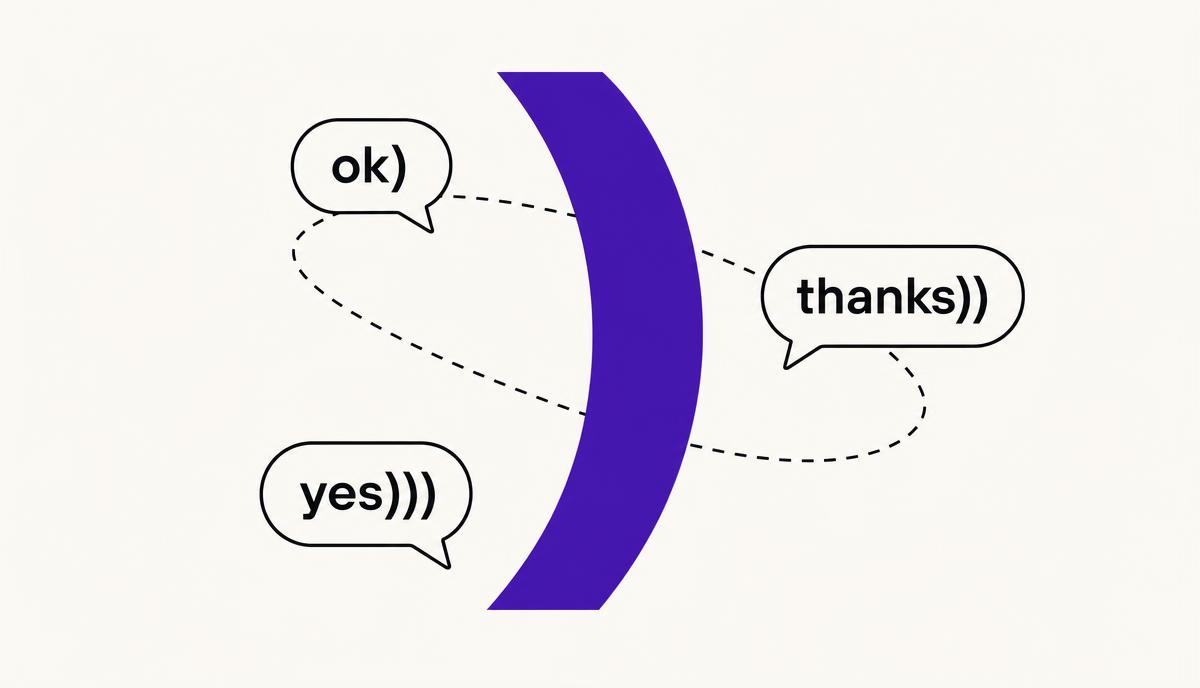
What Does ")" Mean in Chat? The Bracket Smiley, Explained
A lone ")" at the end of a message is a smiley with the eyes left off — and a strong signal you are talking to someone from Eastern Europe. Here is what it means, why it exists, and how to read it correctly.
How to Ask for a Raise by Email (Templates and Scripts)
A practical guide to writing the email that asks for a raise: when to send it, what evidence belongs in it, three templates you can adapt, and the wording that keeps the tone confident rather than apologetic.